
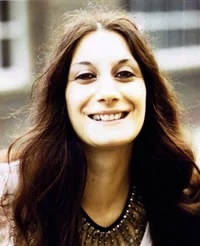
Beverley Martyn, best known for her two records with John Martyn in the early 1970s, died last week at the age of 79. A statement released on the John Martyn website said that “Beverley was a remarkable woman of great inner strength. She was beautiful, intelligent, warm and kind.” Andrew Curry reflects here on her life and music.
So where to start with Beverley Martyn, who released four LPs, two co-credited, and a handful of singles over a period of 50 years? Who was recording while still a teenager? Who knew everyone in the ‘60s folk scene, from Bert Jansch to Donovan to Paul Simon?
Well, perhaps near the end, rather than at the beginning: at Bush Hall in West London in 2014, at a concert to mark her solo album The Phoenix and the Turtle. Mark Pavey, the producer who had worked with her right through from selecting the songs on the record to mixing them, had assembled a band to showcase the titles.

Helen Gregory, writing in KLOF magazine, described it like this:
it was a rare opportunity to catch a live appearance by a great artist whose influence on the British folk music scene of the 1960s and early 1970s has too often been overlooked – and the evening didn’t disappoint… It’s to Beverley’s credit and a measure of her creativity and maturity that she’s been able to reignite a lifetime’s professional career and, in the process, return to the live stage in a way that is both inspiring and uplifting.
The songs on The Phoenix and the Turtle span her entire career: some of the early blues singles she sang as a 16-year old, fronting the skiffle band Levee Breakers, and the song she co-wrote with Nick Drake, previously unrecorded. The set at Bush Hall—some of which can be seen on Mark Pavey’s YouTube channel— also included a song from the sessions she recorded at 18 for the Deram label, and reworked versions of the songs, such as Sweet Honesty and Primrose Hill—much later heavily sampled by Fatboy Slim—that she had contributed to her two records with John Martyn, Stormbringer! and the aptly titled Road to Ruin.
Because Beverley Martyn’s disastrous relationship with John Martyn hangs over her life like a heavy cloud. As Rob Young notes in his book Electric Eden, when she met John, she had three more years’ experience as a professional musician than he did, she had had a single produced by George Martin, her recording of Happy New Year—with Jimmy Page, John Paul Jones, and Nicky Hopkins playing behind her—had launched the Deram label, she had sung at the Monterey Festival, still a teenager, at Simon & Garfunkel’s invitation, and she had just been signed up by Joe Boyd’s Witchseason label, with a solo album deal at Warner Records.
She’d ended up at Witchseason because Denny Cordell, who had produced her Deram sessions that included Happy New Year, didn’t quite know what to do with her. By Beverley Martyn’s account, Cordell was trying to turn her into a British version of Cher. As she told her biographer Graeme Thomson, in an interview for The Guardian,
“He did my songs in a really over-the-top Europop style,” she says. “It was a man’s world. The attitude was: ‘What are we going to dress you up in?’”
Boyd decided to send her to Woodstock to record an album with a group of musicians that included The Band’s drummer Levon Helm. But by this time, she was already involved with John Martyn, who wasn’t planning to pass up a trip to Woodstock.
When released, Stormbringer! had six songs on it by John, and four by Beverley. The musician Ross Palmer, reviewing Thomson’s biography and Beverley’s memoir Sweet Honesty on his website, concludes that the record was better than it would have been as a solo Beverley Martyn album:
But knowing that Martyn elbowed his way into the picture then took over his wife’s artistic project is always there in the background, making listening to the record uncomfortable, as it appears this was an early manifestation of the controlling and abusive behaviour he would exhibit for the rest of their marriage.

In Electric Eden, Young summarises John Martyn in a couple of telling lines, of which the first is most ominous:
Glaswegian John, his father’s son, harboured violence, adultery, the weight of male expectations, and electricity.
And Martyn brought all of these to his marriage with Beverley. After their two records together, he reverted to a solo career, leaving Beverley to look after three young children as he went on tour, and violently abusing her when at home. After ten years of marriage, like other battered women before her, one day she put on her son’s boots and ran to the police station.
As Ross Palmer says,
Reading Beverley Martyn’s book, or even Graeme Thompson’s Small Hours, is often harrowing. Martyn’s physical abuse of Beverley steadily escalated until she left him in 1979. Even after that, the abuse continued in the form of bare-legal-minimum maintenance payments that left her and their children broke in a dilapidated house in Heathfield, sometimes depending on charity from friends, including a visiting Art Garfunkel.
It’s telling, perhaps, that when the music writer Jim Motavalli interviewed Joe Boyd in 2006 about his memoir White Bicycles, he found that Boyd was generous about all of his Witchseason artists, except for John Martyn:
“Boyd had nothing good to say about Martyn… and got us off the subject as quickly as possible.”
By Beverley’s own account, she didn’t stop playing music, but it was mostly for herself, with occasional club appearances. Ill-health and depression didn’t help.
After the children had grown up, Loudon Wainwright invited her to tour with him. She recorded some unreleased songs with Wilko Johnson, and released a no-to-low budget solo LP, No Frills, in 1998, which I’ve not heard and is now out of print, although a club appearance in 2000 in which she sings a version of the double-entendre laden Jelly Roll Blues might give a sense of it. Potter’s Blues, about the television playwright Dennis Potter and which is also on Phoenix, also makes its first appearance on No Frills.
It’s hard to look back at all of this and not to think that the career that she should have had was blighted by misogyny and sexism. John Martyn’s misogyny, obviously, but also the sexism of the men in the 1960s music industry who listened to her strong voice and capable guitar playing, learned from Bert Jansch during their relationship, and worried about her clothes. Her Deram recordings, under the name ‘Beverley’, were finally released as an album in 2018, and by 1960s standards are only a track or two short of enough music to make up an LP.
As Jimmy Page said, looking back on the Deram sessions,
“At the time it was recorded I knew that she was a shining talent in the world of performance and songwriting.”
In 1967, when she made those recordings, John Mayall’s Blues Breakers album had recently been released, Cream had formed in the past few months, and Peter Green was about to form Fleetwood Mac. The British blues boom was just taking off.
Her recordings with the Levee Breakers and as Beverley—and the couple of songs with John Renbourn eventually released on The Attic Tapes—show a real flair for the blues, and yet none of these music industry men (Joe Boyd included) seem to have thought it worth putting her in front of a blues band to see what happened. Somewhere in an alternative universe, you think, Beverley Martyn is as big a star as Christine McVie or Bonnie Raitt.
When Mark Pavey approached her about the project that became The Phoenix and the Turtle, they bonded over Davey Graham, whom Beverley Martyn knew from the 1960s and whom Pavey had helped, in his last years, setting up some concerts and pursuing outstanding royalties.
She told Simon Holland, who interviewed her in 2014 for KLOF magazine,
Mark wanted me to play him everything I had right back to the Levee Breakers and including all of the stuff I’d worked on with other people too, like the song written with Nick. I even played him the first song I ever wrote … He allowed me to do my own thing and try stuff. He wasn’t trying to tell me how something should be sung.
The way she says it, it sounds like the first time that someone had listened to her about her songs and her music.
Reckless Jane, the song written with Drake, is on Phoenix. Drake used to visit the house—and even babysit—when the Martyns lived in north London. In White Bicycles Joe Boyd writes of how Beverley looked after Nick, feeding him and sometimes washing his clothes. There’s a video on Mark Pavey’s YouTube where she talks about their friendship.
The song is not autobiographical, but it nods in the direction of a woman who had a talent to inspire others as well as a talent of her own.
There’s a coda to this part of the story. When the music archivist Neil Storey started assembling the material for the Nick Drake four box set The Making of Five Leaves Left, which we wrote about here last year, the first tapes he had were the demos of Drake’s first studio recordings.
They had been preserved by Beverley Martyn for 50 years, despite her own circumstances. I remember thinking then of the love and care she had given to looking after her friend’s music. It is good that, in the last decade or so of her life, her music finally got some care and attention of its own.
For a more conventional obituary, see Alex Gallacher’s article at KLOF.
—
Do join our growing Salut! Folk Facebook group at https://www.facebook.com/groups/2902595146676633/. You’ll get there straightaway if you’re already on Facebook.

Leave a Reply to Christopher DavidCancel reply