
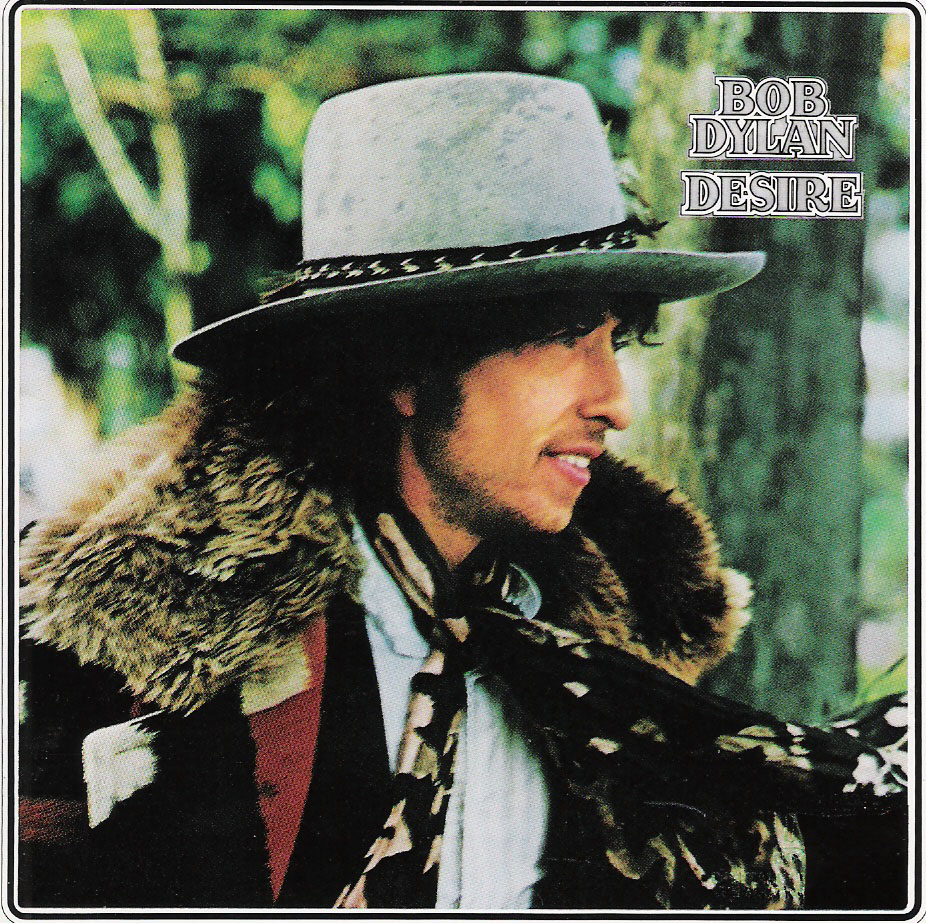
Steve Peck writes: It’s 50 years this month since the release of Desire, Bob Dylan’s 17th studio album. After the quiet introspection of Blood on the Tracks, Dylan changed gears and created a new musical sound that would echo through the work of artists like John Mellencamp and the rise of the Americana movement.
The mid-1970s marked a pivotal moment for a unique artist. Bob Dylan’s Desire and the Rolling Thunder Revue were unlike anything the great song master had attempted before. While the concerts were transient, to be experienced in the moment, the album remains a time capsule documenting the birth of another Dylan persona, one that would influence his work and shape his image across the next decade.
By 1975, Dylan stood at a crossroads. Looking for a new direction, he cast off the shuttered skin of his previous incarnation and revealed a more open, colorful version of himself, both musically and in the public eye.

After the monumental Blood on the Tracks, Dylan’s muse was clearly intact, yet he surprised many by turning to creative collaboration. He met Jacques Levy, a well-known theater director and songwriting partner of the Byrds’ Roger McGuinn. They shared an affinity and began working together.
Levy’s input was significant. He co-wrote many of the lyrics and offered ideas that helped shape the compositions narrative. As their material came together, Dylan began assembling a new band for both the studio and the road.
Spotting an eye-catching young woman with long black hair walking down a New York City street with a violin case, Dylan called from the backseat of his limousine and invited her to a recording session. Impressed by what he heard, he soon made the previously unknown Scarlet Rivera a prominent fixture in his growing troupe.

Not credited. – Tulane “Jambalaya” yearbook, 1976. Via [1]
By mid-July he enlisted 21 musicians for the recordings, including Eric Clapton, Emmylou Harris, and Rivera. The sessions were famously chaotic, with little time to learn the material and rehearse. After paring down the cast and Clapton’s voluntary departure, the core group began to gel, later forming the nucleus of the Rolling Thunder Revue.
As the tour ramped up, the reticent folk hero transformed into the striking frontman of a traveling gypsy circus, performing a handful of his newest songs. Their swirling melodies, colorful tales, and Rivera’s soaring violin lay at the heart of the show, defining the Rolling Thunder ethos.

Photo: Ken Regan
After the fall leg of the tour, Desire was released in the first week of January 1976. It was Bob Dylan through and through, but more theatrical and cinematic, focusing on storylines that were spun like modern myths.
Musically, the album snaked along a winding path, its sense of motion and release driven by Rivera’s sinuous violin and the heavy punctuation of the drums. Emmylou Harris’s backup vocals sweetened the deal.
While the album ventured into new territory, it opens with Hurricane, an old-school protest song about the plight of boxer Rubin “Hurricane” Carter, jailed for a crime he did not commit, yet it feels anything but dated.
Isis is a panoramic saga, crackling with intensity, a modern myth unfolding in related scenes rather than the imagistic impressions of Dylan’s mid-60s work.
One More Cup of Coffee, widely regarded as the standout track on the record, has been covered by numerous artists. Its melody has a borderless, exotic quality, while Rivera’s expressive violin serves as another lead voice, almost a co-narrator.
Other highlights on Desire include Oh, Sister and Sara. The former offers a refuge of reconciliation, while the latter is the most direct love song Dylan has ever written for his wife. Sara stands out as the only deeply personal track on the album, with its bare openness almost shocking within the context of his career.
The most controversial tale on the album is Joey, an overly long eleven-minute ode to notorious gangster Joey Gallo. Dylan and Levy lionize Gallo as a romantic outlaw hero, like Woody Guthrie’s Pretty Boy Floyd, rather than the ruthless thug he was. Opinions were divided and drew its share of criticism.

Gallo mugshot taken by the New York City Police Department
To make room on the record for Joey, Dylan set aside the track Abandoned Love, though many consider it far superior. When it finally appeared in 1985 on the box set Biograph, it proved what an outstanding addition it could have been. Discarding some of his best material is a pattern Dylan has repeated throughout the years.
Looking back on Desire after all these years, I’ve come to see the album differently. At the time of its release, I was disappointed that it wasn’t Blood on the Tracks 2, although with hindsight this was the viewpoint of a naïve teenager, still relatively new to Dylan.
While I quickly grew to love it on its own terms, I’ve always felt the absence of a certain undefinable personal spark that runs through so much of his work, even at his most obscure. Maybe that’s just the Jacques Levy element.
The album’s musical foundation and Dylan’s evolving rock star persona influenced his next fifteen years of work, yet Desire remains one-of-a-kind in his oeuvre.
1975 marks a watershed moment when he left the past behind and forged a new course, something he has done several times since. It deserves its distinguished reputation as an important, adventurous work and should be celebrated. Happy 50th birthday!
Steve Peck also writes at his Facebook music blog Hickory Notes.
Join the Salut! Live Facebook group. Visit us at https://www.facebook.com/groups/2902595146676633. You’ll get there immediately if you’re already on Facebook.
Leave a Reply