

It is 50 years since Bob Dylan’s Rolling Thunder Revue opened in Massachusetts. It was the anti-rock tour–a rambling cast of Dylan’s friends and assorted glitterati hit the road to play small venues across America’s north-eastern states and into Canada. To mark the anniversary, Salut Folk will be running three pieces this week. We’re also sharing some of the Dylan pieces from our back pages on the home page–just scroll down.
Part Two will look at the role of the ‘rock star’ playwright Sam Shepard in documenting the tour, and in Part Three Salut’s Bill Taylor writes about the Revue’s final gig in New York, which he was there to see. To kick the series off, our North American editor Steve Peck offers a freewheelin’ overview of the fabled convergence from the perspective of a self-effacing scribe in 2025.
Steve Peck writes: Rolling. Thunder. Revue.
1975 — The Fourth Coming of Bob Dylan. The greasepaint minstrel and his ragamuffin tribe of rabble-rousing ruffians and gypsy queens. Heading toward your town.
Who saw it coming? Was this family-man Bob with his corn cob pipe? The zonked-out, polka-dotted, electrified Harley rider? The voice of the Dust Bowl echoing through the prism of a civil rights march?
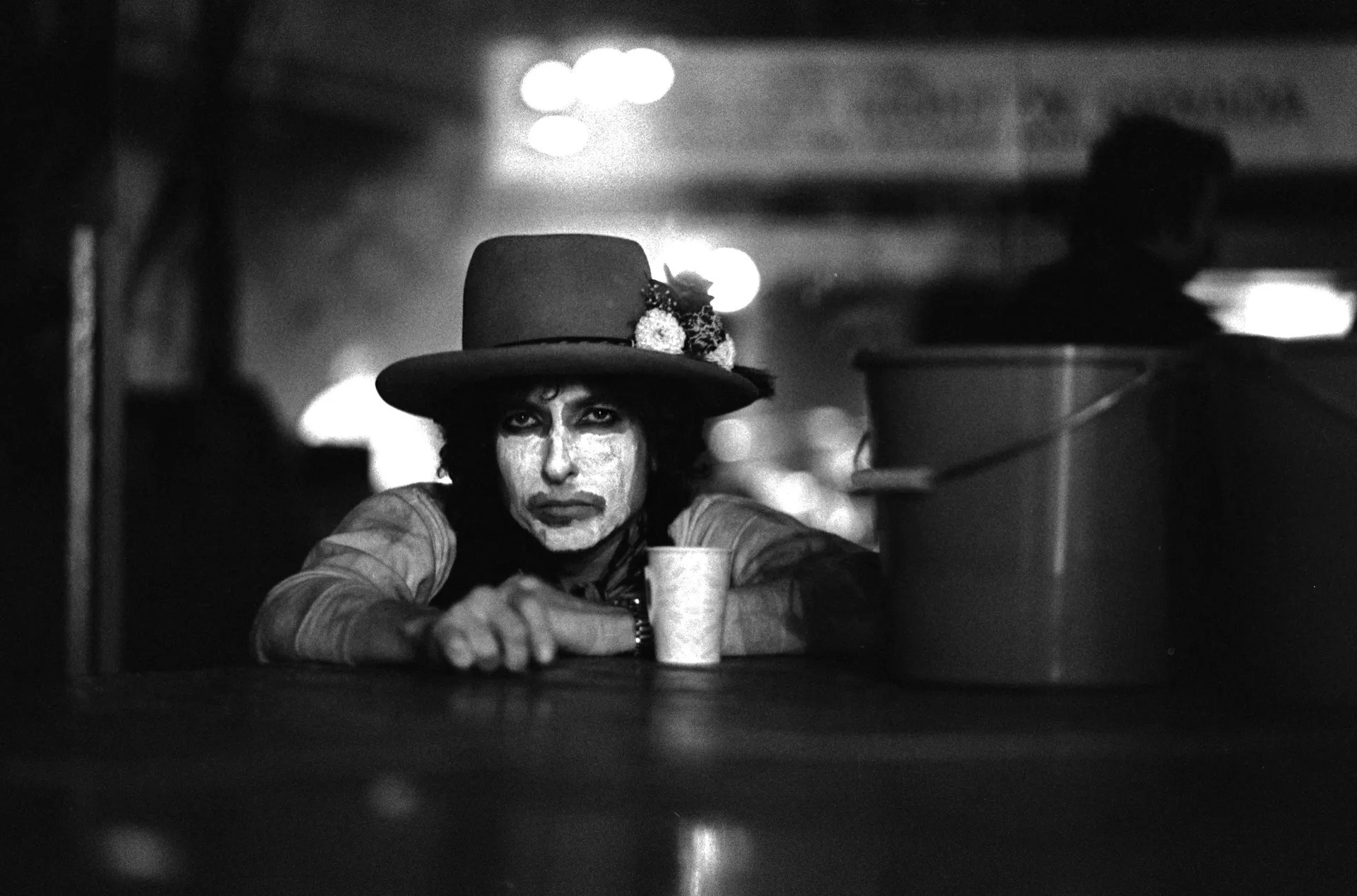
Photo by tour photographer – Ken Regan.
The answer was no: Dylan turned the music world topsy-turvy in 1975 by shape-shifting into the enigmatic ringmaster of an old-time traveling revue. Gone was the elusive recluse who secluded himself in the hills of Woodstock, New York.
Smaller venues
After scouring the lonely waterfront docks of Blood on the Tracks, Bob watched the sun rise from his dingy hotel room. Ripping asunder the stagnating conventions of a ‘rock tour,’ Dylan saddled up his gypsy caravan of rotating musicians, writers, poets and artists, and set off for less populated towns, playing smaller venues, getting up close to astonished audiences.
All that was missing were the healing tinctures of a Wild West medicine show.

When the Rolling Thunder Revue hit the stage on opening night, October 30, 1975, in Plymouth, Massachusetts, Dylan had assembled such roguish characters as Bobby Neuwirth, Joan Baez, Roger McGuinn, and David Bowie’s guitarist Mick Ronson to share the spotlight.
Backing them was a fiery band including T-Bone Burnett, Rob Stoner, David Mansfield, Ronee Blakley and a mysterious discovery: violinist Scarlet Rivera, whom Bob found on the streets of New York City.
To chronicle the affair, Dylan brought along several filmmakers and playwright Sam Shepard to help draft a loose, interpretive narrative from the footage.

Photo by Ken Regan. Note: T-Bone Burnett and Mick Ronson on Bob’s right.
Onstage, a freshly reincarnated Robert Zimmerman sported a beflowered gaucho hat, white face paint, flowing scarf and a dapper fitted vest. This mythical visage firmly embraced his place in musical history, only to roll it up, smoke it, and vanish each night in a puff of improvised mischief.
Ziggy solos
Several well-known songs got complete makeovers. A Hard Rain’s A-Gonna Fall morphed into a rollicking blues shuffle, à la Highway 61 Revisited, complete with glam-baked Ziggy solos by Ronson.
The Nashville Skyline chestnut, Tonight I’ll Be Staying with You, burst alive with crackling energy, spurred by a freshly penned set of lyrics. It Ain’t Me, Babe soared.
Dylan also sprang six vibrant new songs on the unsuspecting crowd; they became the beating heart of his next album, Desire, released the following January. They fitted the Rolling Thunder ethos to the T.
Co-written with lyricist and stage director Jacques Levy, these were technicolor tales of a love-lorn seeker on an existential quest, a wrongfully incarcerated prizefighter, a sanctified mafioso, and a constellation of mysterious women. To animate the spirited fables, Rivera’s violin swirled and danced, carrying her gypsy-kissed strings to the rafters.
Duetting with Joan Baez
Lighting up the sky were Lord Bob’s duets with Lady Joan (Baez). Their performances transformed the audience’s grainy black-and-white memories of yesteryear into a rainbow-hued, reflective panorama of ardor. Think Blowin’ in the Wind and The Water is Wide, a true folkie’s dream.
Other luminaries hopped on board for a night or five, keeping the proceedings loose and unrestrained. Joni Mitchell, Ramblin’ Jack Elliott, Gordon Lightfoot, Arlo Guthrie, Kinky Friedman, Dennis Hopper and the Beat Beacon of Bohemia himself, none other than Allen Ginsberg, imbued the atmosphere with their spellbinding talents.
Running through the northeastern US and into Canada, the first leg of the Revue concluded in early December. Following the release of Desire, they hit the South in April ’76 for a month.
Unfortunately, a number of Dylan’s cohorts had moved on, and the parade lost some of its magical vibrations. To help allay significant costs, Dylan brought the show to bigger barns and auditoriums, which compromised the intimacy of the earlier run.

The Bard & Allen Ginsberg at Jack Kerouac’s grave. Photo – Ken Regan
The Hard Rain album
Later in 1976, a live artifact of the second leg appeared as the Hard Rain album and TV concert. It was a ragtag affair that had its moments, but as a young listener, I couldn’t detect the effusive transcendence that the music press had bestowed upon the tour.
In 1978, Dylan’s ill-fated conceptual Rolling Thunder Revue movie, Renaldo and Clara, landed with an earthquaking thud and proceeded to burial with alarming quickness. Sometimes lofty intentions go sideways.
It wasn’t until 2002, with Columbia’s release of The Bootleg Series Vol. 5 – Live 1975, that I truly heard the magnitude of the tribe’s wizardry on those smaller stages. Recorded at various shows during the fall of ’75, the songs were arranged to resemble Mr. Zim’s setlist.
Never had the music world seen or heard the likes of the Rolling Thunder Revue, nor has it since. Fifty years is a long time — but is it? The flame still flickers in mythological lore, kindling plumes of speculation and inspiration. The mystery of Bob Dylan.
Rolling on. Thunder resounding.

Lady Joan & Lord Zimmerman – Photo Ken Regan
—
Read on! Part 2 is here:
Steve Peck also writes at his Facebook music blog Hickory Notes.
It costs us some money to run Salut Folk, with hosting fees and so
on. If you’d like to support our work, feel free to ignore the donation
figures suggested by Buy me a Coffee in the link below. Just type in
your own sum.
https://cdnjs.buymeacoffee.com/1.0.0/button.prod.min.js
Join the Salut! Live Facebook group. Visit us at https://www.facebook.com/groups/2902595146676633. You’ll get there immediately if you’re already on Facebook.
Leave a Reply