
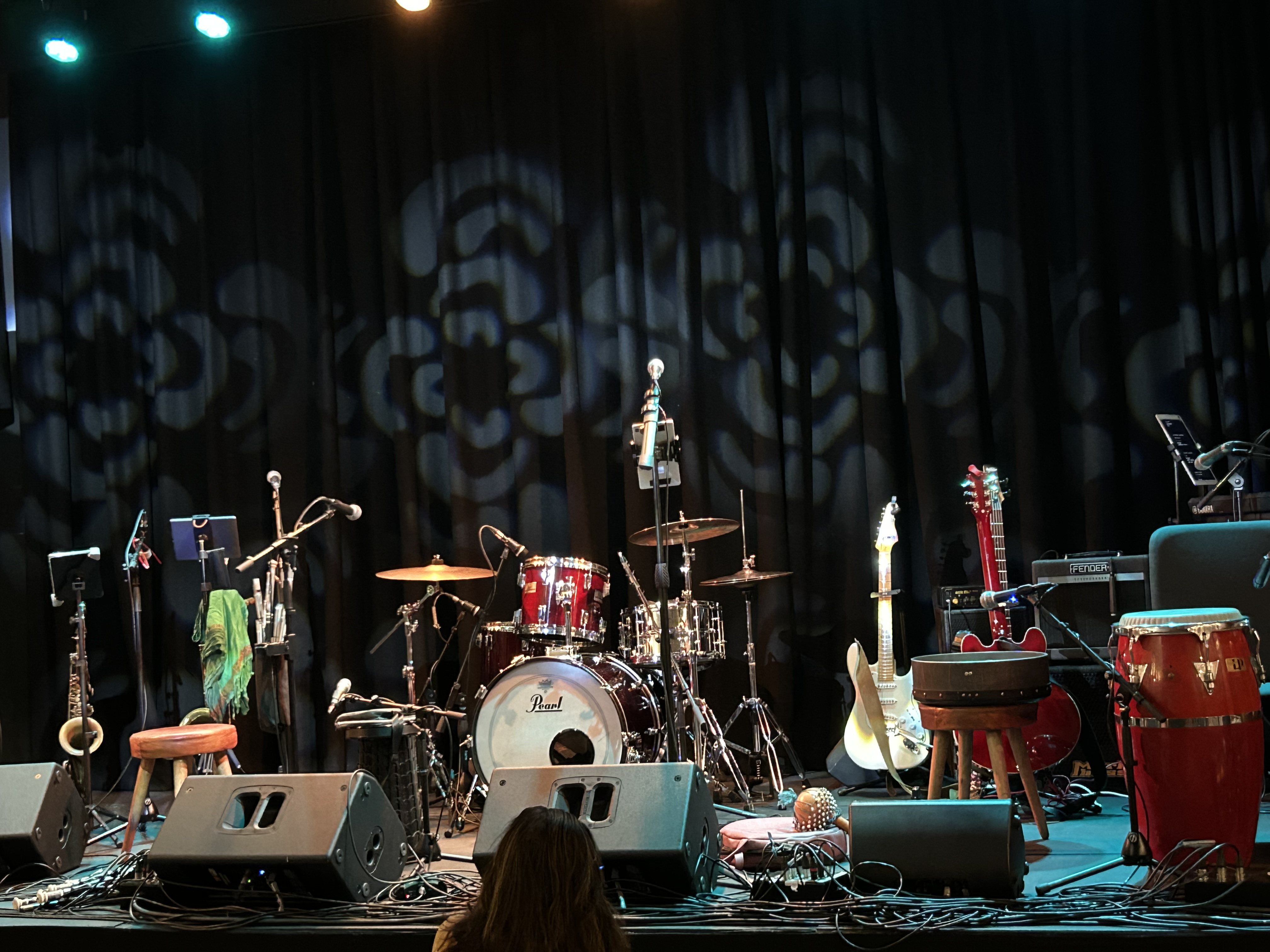
Andrew Curry writes: “Have you ever thought about what would happen if Africa was right next to Ireland? The world would be a better place.”
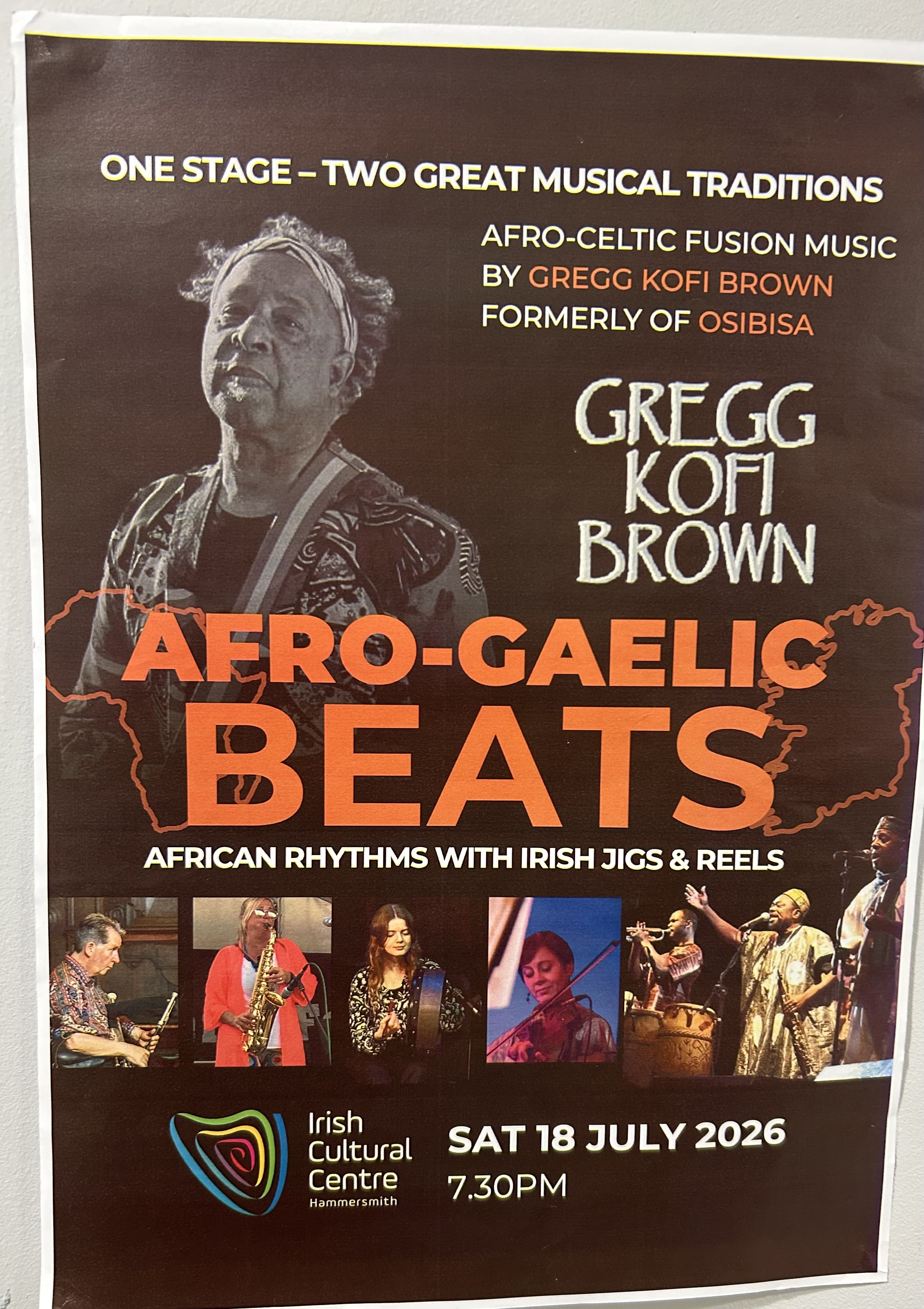
Gregg Kofi Brown, best known for his time with the African band Osibisa, is on the stage of the Irish Cultural Centre in London introducing the Afro-Gael Beats, a combined band of African and Irish musicians. It’s a big band: 11 musicians, who certainly fill the compact stage at the Cultural Centre.
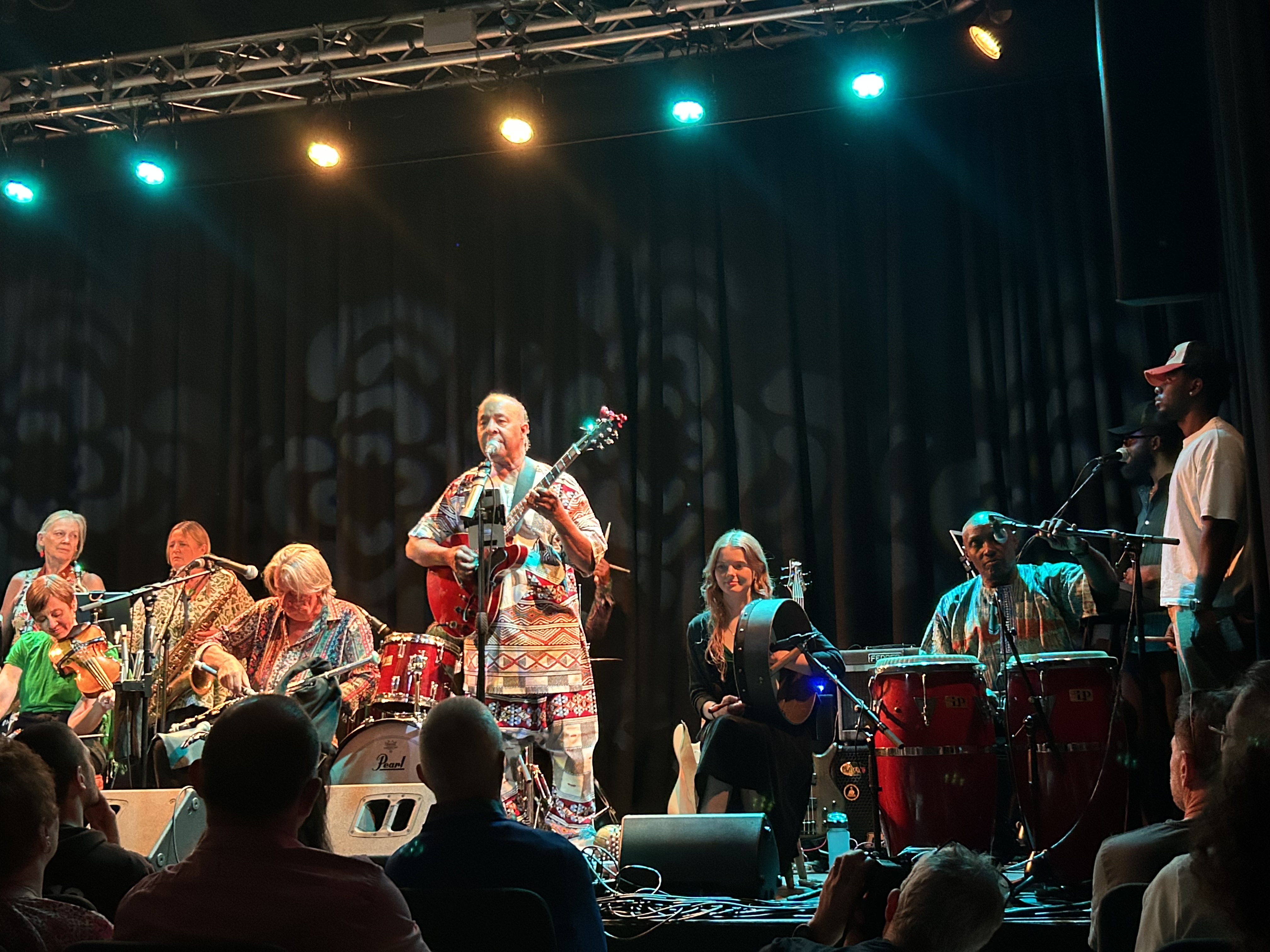
And they hit the ground running, with a version of Osibisa’s song Fire. The percussion section, which drives the song along, consists of drums (Awillo), congas (Awala), cowbell, and bodhran (Holly Fitz). There are two keyboard players (Gabriel Yeboah and Eben Kwaw), a brass section of two saxes (Clare Hirst and Caz Devine) and a trumpet (Claude Deppa), a fiddle (Ali Monaghan) and pipes (John Devine), with Kofi Brown on guitars.
We’d gone on a whim. It seemed like a better evening than watching 22 disappointed men going through the motions in FIFA’s so called bronze medal final.[1]
It turned out that this is the third time that the Afro Gael Beats had played at the Cultural Centre, although I’d missed the previous outings. There have been similar combinations before—I’m thinking of Simon Emerson’s Afro-Celt Sound System, and Danny Thompson’s work with Ketama as Songhai.
As it happens, I have a bit of history with Osibisa. They were the first African band to break through in the UK, in the early 1970s, and as a teenager I saw them at the 100 Club in London. I saw them again almost 50 years later, and although most of the personnel had changed, there was still one musician there from the first version of the band.
Kofi Brown has played with Osibisa on and off for close to 40 years, and many of the songs tonight are from Osibisa’s repertoire, along with songs he’s recorded solo.
And so we get versions of Ayiko Bio and Ke Le Le, as well as The River, a more recent song that he co-wrote with Ed Sheeran. The sound is, if I’m honest, more African than Irish. The bodhran, played by Holly Fitz, fits right in with the percussion section, and adds something to it.
The traditional Irish fiddle and pipes, played by Ali Monaghan and John Devine respectively, tend to get a bit lost when the brass section is in full swing. When John Devine picked up a whistle, which you can just about hear in the mix, it reminded me of the story about The Pogues repeatedly having to tell Steve Lillywhite to push up ‘Spider’ Stacey’s whistle playing when he was mixing Fairytale in New York.
The Irish elements work best when the fiddle and the pipes are able to add some tunes over the percussion. The rest of the sound is quiet enough for these quieter acoustic instruments to cut through. Listening to it, you realise that one of the reasons that this combination works is that both African music and Irish music are forms of serial music, based on repeating patterns. It won’t work for the pipes, of course, but maybe Ali Monaghan could try a fiddle that she could plug into an amplifier.
When the band hits its groove, it certainly swings. The interplay of the brass section is terrific, and Gabriel Yeboah’s keyboards, particularly his electric piano, add sparkle. Kofi Brown, who has a charismatic stage presence, presides from the middle of the stage.
Kofi Brown has played with a lot of people—not just Ed Sheeran, but, on his solo album, Sting, the jazz drummer Billy Cobham, Des’ree, Gabrielle, and the guitarist Stanley Jordan. So he’s clearly here, hanging out with these Irish musicians, because he wants to be. And he says some very warm things about John Devine (“a genius”) as he tells us that he’s planning to record the Afro Gael Beats. Certainly, watching the musicians on stage, they’re having a good time. Sadly, there’s not even a single track to be found of the band on youtube.
The set closes with Sunshine Day, one of the Osibisa classics, and also their most popular song on Spotify. By this time quite a lot of the audience are on their feet, which doesn’t often happen at the Irish Cultural centre. It was a perfect way to spend a warm summer evening.
[1] The miracle of recording technology meant that I was able to watch the match later, without knowing the score.
—
If you like folk, folk-rock or acoustic music, do visit the Salut! Folk Facebook group at https://www.facebook.com/groups/
Leave a Reply