

Andrew Curry writes: Kris Drever has been touring to promote his most recent record, Doing This For Love, and he opened his set at King’s Place in London by playing four songs from it, reeling them off. This included the first three tracks on the record, Doing This For Love, Change, and Bring Back Hanging Around.
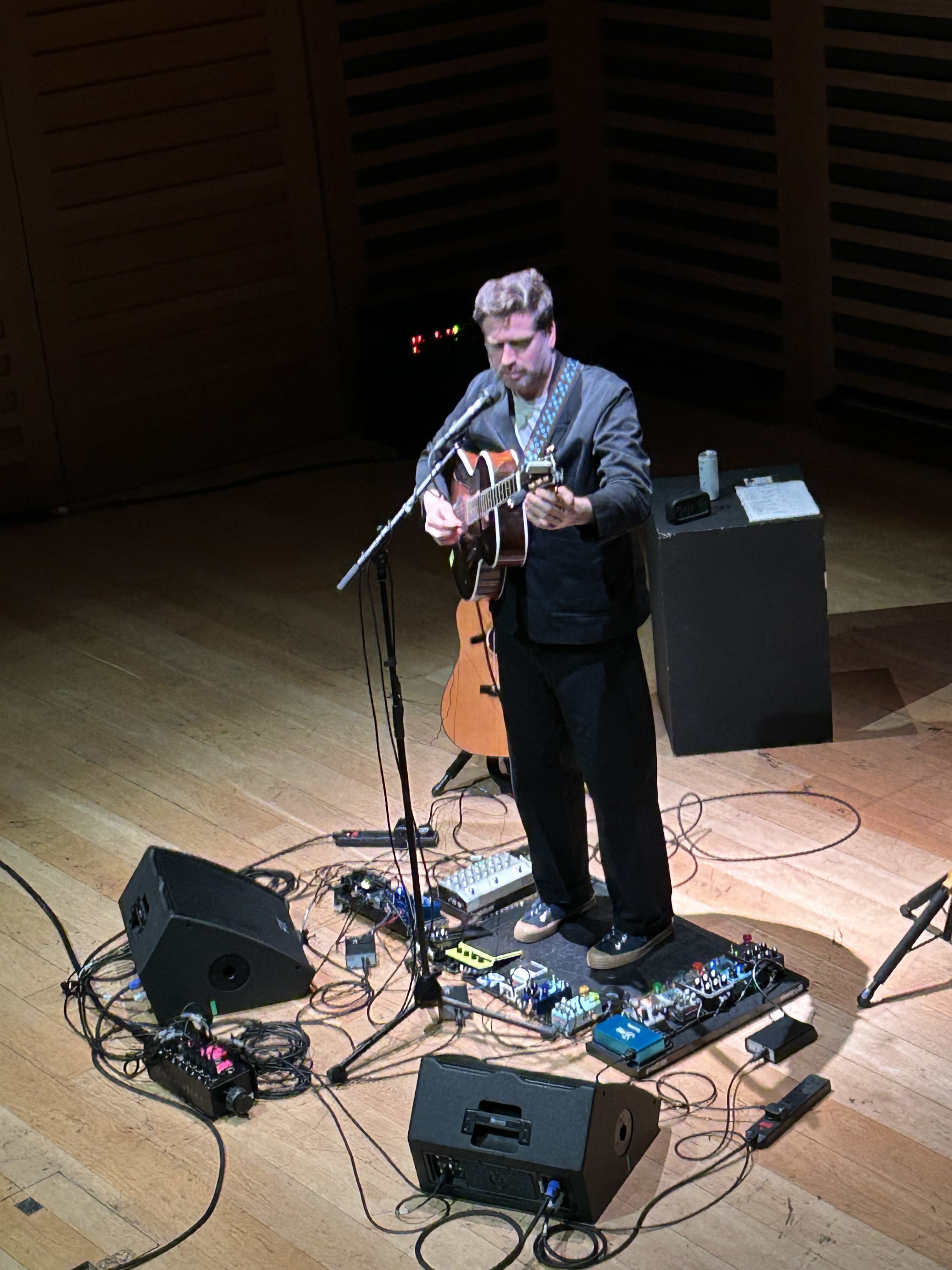
(Kris Drever at King’s Place. Photo: Andrew Curry CC BY-NC-SA 4.0)
He wasn’t apologetic about this, but he did offer an explanation:
New songs aren’t the most favoured part of any performance. But they can’t become old songs any other way.
Kris Drever had been touring with Annie Dressner, who has been opening for him, but at King’s Place, where he was appearing as part of their folk weekend, he’s on his own for the whole show. This means that there’s extra material being slotted into the set list. It’s him, his two guitars, and the bunch of electronics at his feet that every self-respecting solo performer travels with these days.
A few songs in he swaps his acoustic guitar for his semi-acoustic, and the difference is striking. The sound cuts through and showcases his fine guitar playing. I’m not a guitar buff, but I asked him about it at the merch stall afterwards, and it’s a relatively new guitar. He’s had it for four years, and it was made in Govan—once better known for its shipbuilding—by Cranmer Guitars.
In between songs from the new record, Kris Drever gave us what he called “folk songs”, such as a 200-year old whaling song The Greenland Whale Fisheries (“are there any fans of whaling in tonight?” he asked as he introduced it. “I see one hand up there—you’re a brave man”).
The Cranmer guitar came into its own during the two instrumentals slotted in, one in each half. The second half instrumental was the air Lament for Glencoe before he segued into his early song Steel and Stone. Afterwards, he explained that during the tour he’d ended up playing successive gigs in Aberdeen, on Skye, and then in Devon.
Even getting from Aberdeen to Skye takes hours of driving, but the route took him through Glencoe, which had reminded him to play the tune. Glencoe is always a desolate place, and always associated in Scottish memory with the 17th century massacre of members of the MacDonald clan by government forces.
A couple of the songs in the set, and on Doing This For Love, originated as commissions. I’d heard him sing Catterline before, commissioned to celebrate the Scots artist Joan Ardley. Pilot Whales was part of a BBC series, 21st Century Folk, that honoured people who had done something extraordinary.
Emma Neave-Webb, a marine conservationist who lives on the Orkney island of Sanday, had prevented a school of pilot whales from beaching themselves by rounding up her neighbours and getting them to stand on the shore banging pots and pans for as much as they were worth. The noise turned the whales away from the beach.
Kris Drever explained that although this was an engaging story, it wasn’t quite enough for a song. A bit more research and he got to what had led to her interest In pilot whales, which had taken her to Orkney. The resulting song reminded me a bit of of Martin Simpson’s song Ken Small, about a man who decided to raise a World War II tank from the seabed off Devon, even if Emma Neave-Webb seems less driven. The BBC video show him performing the song to her, possibly in her front room in Sanday.
The 21st Century Folk series, on Mark Radcliffe’s Folk Show, is also a reminder that the real strength of the BBC is as a British cultural institution, which tends to get lost in endless discussion of its news coverage.
Drever talked a bit about songwriting as he introduced his song Scapa Flow 1919, about the sinking of the captured German fleet in Orkney after World War I. He was a little tongue in cheek as he explained that when you looked at internet sites on songwriting, or even when you taught it, people talked about the value of “universality”. So, he said, “here’s a song about the German navy in 1919.”
The timing of the joke was good, but this also reminded me that the real secret of “universality”—which I learnt in my short and unsuccessful career in film production—is often when the very local speaks to the universal. The reason why Scapa Flow 1919 works as a song is it has a universal theme, of desperate men who have had everything stripped from them doing the only thing they can do to regain their pride.
There is always humour at a Kris Drever gig, and his encore certainly put a smile on my face. He explained that one of his guilty secrets was playing mandolin in pub music sessions, and that this was his favourite piece for the end of the evening. He didn’t pull out a mandolin, but he did go into the much-covered standard That Lucky Old Sun: “That lucky old sun has got nothing to do but roll around the sky all day.”
Drever didn’t talk about this on stage, but from a bit of research I discovered that he’d been working on the songs on Doing This For Love since the pandemic, but in the middle of last year he’d lost confidence in the material.
His collaborator Euan Burton—who plays bass and organ on the record, and co-produced it with Drever—told him just to get into the studio for a few days as soon as he could.
He convinced me to just book the next available few days in GloWorm studios and start recording. As soon as we started tracking, the doubts disappeared, it all made sense. Just do the work, be present, be kind to yourself.
And by September, the record was finished.
—
Leave a Reply