
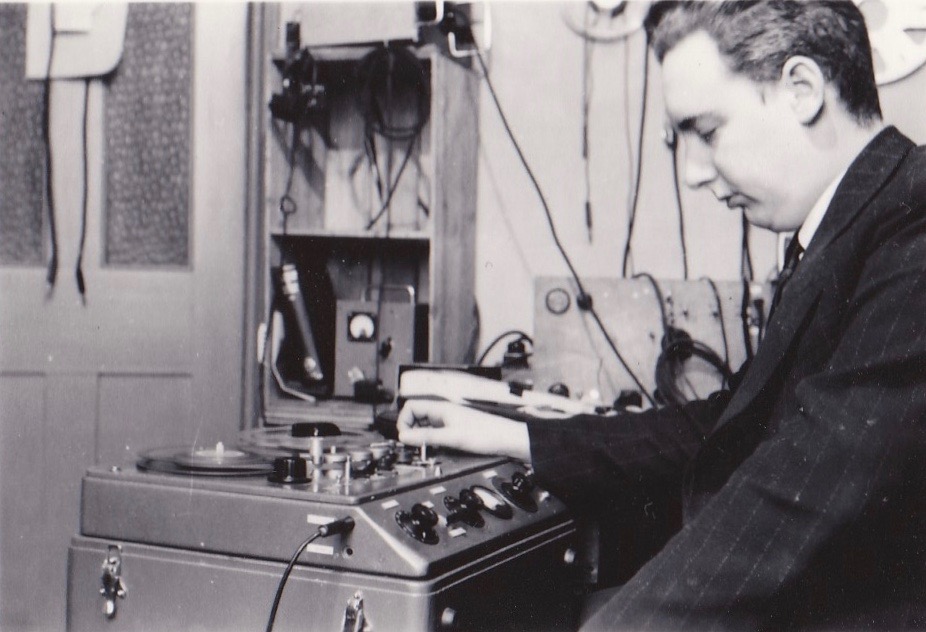
Colin Randall writes: There is a decent human tendency to speak well of the newly deceased, magnifying their achievements and minimising any defects or failures. With Bill Leader, there is not the least reason for exaggerated acclaim.
Leader led. It really is as simply as that. Without his genius as a recording producer and engineer, British folk over the past 60 years would have looked and especially sounded a lot different, and emphatically not for the better.

(Bill Leader at the offices of the Workers’ Music Association in the 1950s. Photo: Bill Leader collection via TheMeteor.org)
A glance at the host of artists he helped in the studios, making their albums all the more magical, speaks for itself. The lists are from Wikipedia:
- Woody Guthrie’s Blues (1955) – Rambling Jack Elliott[11]: 65–66
- Her Mantle So Green – Irish Street Songs And Fiddle Tunes (1965) – Margaret Barry & Michael Gorman. [Note: Recorded By – Bill Leader in 1955-1957 (tracks: A1, A3, A6, B1, B3 to B6), Ewan MacColl in 1965 (tracks: A2, A4, A5, B2)]
- John Gibbon’s Disc (1957) – John Gibbon
- Peggy Seeger (1957) – Peggy Seeger
- Nancy Whiskey Sings (1957) – Nancy Whiskey[12]
- 3/4 A.D. (1962) – Alexis Korner & Davey Graham
- The Iron Muse (A Panorama of Industrial Folk Songs) (1963) – compiled by A. L. Lloyd with Anne Briggs, Bob Davenport, Ray Fisher, Louis Killen, Matt McGinn and The Celebrated Working Man’s Band
- Bert Jansch (1965) – Bert Jansch
- A Wild Bees Nest (1965) – Paddy Tunney
- Jack Orion (1966) – Bert Jansch
- The Irish Edge (1965) – Paddy Tunney
- The Watersons (1966) – The Watersons
- The Young Tradition (1966) – The Young Tradition
- Ireland Her Own (1965) – Paddy Tunney and Arthur Kearney, with Joe Tunney and Frank Kelly
- So Cheerfully Round (1967) – The Young Tradition
- Morning Stands On Tiptoe (1967) Dave and Toni Arthur
- Mason’s Apron (1967) – The Dubliners
- Mainly Norfolk (1968) – Peter Bellamy
- Matt McGinn (1968) – Matt McGinn
- Paddy in the Smoke: Irish Dance Music from a London Pub (1968) – Various artists
- Humble Beginnings: The Complete Transatlantic Recordings, 1969–74 – Billy Connolly
- The Humblebums (1969) – The Humblebums
- Fair England’s Shore (1969) – Peter Bellamy
- The Lark In the Morning (1969) Dave and Toni Arthur with Barry Dransfield
- Young Hunting (1970) – Tony Rose
- Cruel Sister (1970) – Pentangle
- Hearken to the Witches Rune (1970) Dave and Toni Arthur
- New Humblebums (1970) – The Humblebums
- Mr. Fox (1970) – Mr. Fox
- Reflection (1971) – Pentangle
- He Came From the Mountains – Bob & Carole Pegg
- Rosemary Lane (1971) – Bert Jansch
- Tir Na Nóg (1971) – Tír na nÓg
- Tear and a Smile (1972) – Tír na nÓg
- Prosperous (1972) – Christy Moore
- A Lancashire Lad (1972) – Mike Harding
- Bright Phoebus (1972) – Mike and Lal Waterson
- No More Forever (1972) – Dick Gaughan
- The Boys of the Lough (1973) – The Boys of the Lough
- Swan Arcade (1973) – Swan Arcade
- Tell It Like It Was (1975) – Peter Bellamy
- The Barrack Room Ballads of Rudyard Kipling (1976) – Peter Bellamy
- Kist O’Gold (1977) – Dick Gaughan
- The Noah’s Ark Trap (1977) – Nic Jones
- Gerry Rafferty (1978) – Gerry Rafferty
- From The Devil To A Stranger (1978) Nic Jones
- Oddfellows; The Oddfellows (2011)
- Shreds; Ian Reynolds (2012)
- That Was Then This Is Now (2013) – Hunter Muskett
[edit]
- Jack Takes the Floor (1958) – Ramblin’ Jack Elliott
- Chorus from the Gallows (1959) – Ewan MacColl
- Red Hot from Alex (1964) – Alexis Korner
- Bert and John (1966) – Bert Jansch & John Renbourn
- Another Monday (1967) – John Renbourn
- Sweet Primeroses (1967) – Shirley Collins
- Rags, Reels & Airs (1967) – Dave Swarbrick
- True Hearted Girl (1977) – The Watersons
- Her Mantle So Green – Margaret Barry & Michael Gorman
Just looking at that parade of excellence rekindles memories of the vibrant folk scene of the mid-1960s and thereafter.
For all that he became so closely linked to the development of folk music in Britain and Ireland, Bill Leader was born in New Jersey, USA. His parents were British and the family moved to the UK when he was a child, living in Dagenham, Mottingham and Shipley.
He realised as a young boy that he wanted to be a recording engineer. From 1955, he worked in a film library at the Polish embassy before finding a niche at Topic records. To make ends meet, he also worked at the Collett’s folk, blues and jazz record shop in London’s Oxford Street. This led to an introduction to Nathan Joseph, founder of Transatlantic records, and he worked part-time with him as a producer.
As his biographer Mike Butler has noted, for Bill Leader, the music was inseparable from his politics:
“[N]o job could ever be as thrilling as selling records for “this bunch of nuts in London called the Workers’ Music Association.” He helped found a branch in Bradford in 1953 then volunteered at the national HQ on Bishops Bridge Road, London, becoming production manager at the Topic record club at just the moment folk music was being reclaimed as a vehicle for political struggle.”
With limited budgets, folk artists had to make do with rudimentary recording techniques. Leader recorded many artists in his front room. John Renbourn recalled an album with Bert Jansch for which Bill Leader installed the tape machine in the sink, “having us play in the broom cupboard”.
He would go to launch his own labels, Leader and Trailer, and to head the Audio Department at the University of Salford. In 2012, he received a Good Tradition award for contributions to continuing the tradition of folk music at the BBC Radio 2 Folk Awards.
Many tributes have been paid and one sums up Bill Leader’s work and generous nature.
Joe Boyd, another American-born pioneer of much that is best in British folk and folk-rock and himself 83 year old, posted this:
“Very sad to learn of the passing of Bill Leader. Bill was responsible for so many of the great recordings of British folk music, from Martin Carthy to the Watersons to a cornucopia of traditional singers and instrumentalists from across the British Isles. He was a wonderful teacher from whom I learned so much, a generous spirit beloved by all he touched. May he rest in peace.”
Salut! Folk echoes those thoughts.
Leave a Reply