

Andrew Curry writes: Transatlantic Sessions is the road show that keeps on rolling. It’s a bit more than a decade since the last television series was recorded, but the live version of the show is still able to fill London’s Royal Festival Hall after a couple of concerts at this year’s Celtic Connections, and as far as I can tell, also the large venues along the way on its short tour of Scotland and England.
The secret of Transatlantic Sessions is that it is always different, always the same. What’s the same: the musical directors are the Scots fiddle player Aly Bain and the American dobro-ist Jerry Douglas, as they have been almost throughout. The “house band”, always outstanding, has evolved slowly over the years, but the core of the band tonight is much as it was when Salut Folk last saw them play in 2023.
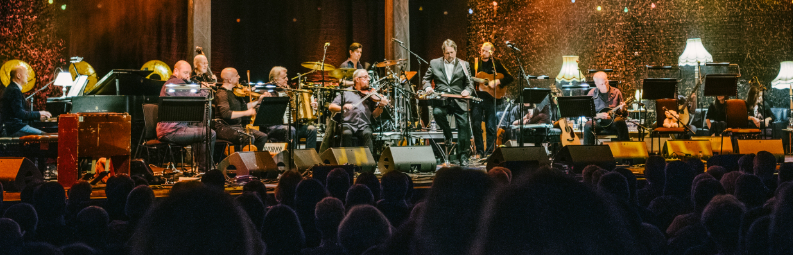
Mike McGoldrick is on pipes and whistles, with John McCusker on fiddle and their trio partner John Doyle on guitar. John Mackintosh plays drums, with Daniel Kimbro on bass. Phil Cunningham is not touring this year, sadly, but Donald Shaw has stepped into this large gap. And the band is completed by the bluegrass players Allison de Groote (banjo) and Tatiana Hargreaves (fiddle).
What’s different is the rotating cast of singers—different every year—who bring their songs to shape the repertoire. This year, they are travelling with Kathy Mattea, the country star who features in series 1 of the TV show, the singer-songwriter Darrell Scott (series 3), the Irish singer Muireann Nic Amhlaoibh (series 5), and Karine Polwart.
Anyone who likes music remembers the six television series fondly, and they are a presence in the hall. When Kathy Mattea plays the Dougie MacLean song Ready for the Storm, she tells us that she learnt it from singing with him on Transatlantic Sessions. When she later recorded it for one of her own records, the royalties paid for Dougie’s conservatory.
Later on Darrell Scott, similarly, reprised from series 2 his song You’ll Never Leave Harlan Alive, this time in a duet with Kathy Mattea. Scott comes from a mining background and the song is a tribute to his grandfather. As he said, “I guess mining is the same everywhere in the world.”
I’ve been wanting to see Muireann nic Amb Amhlaoibh perform in person for a while now—I listened to a lot of her music last year— and she didn’t disappoint. She’s apparently singing some “new old” songs, and started with one that had been written by the great Irish 18th century musician Turlough O’Carolan, and popularised by Planxty in the 1970s.
By her account, the song—Si Bheag, Si Mhor is “quite violent and quite bloody, but it’s in Irish, so it sounds lovely.”
In the second half she sang an equally old song, from the depths of the English repression of Irish Catholics. I didn’t catch the name, but the chorus was used as a code to let people know if a secret Mass was happening or not. Donald Shaw’s piano accompaniment was magnificent.
When Karine Polwart came on, she observed that one of the pleasures of Transatlantic Sessions is the opportunity to play with such a large group of musicians—she plays most of her concerts on her own. Another was the chance to perform in a storied venue like the Royal Festival Hall, which carries “the memory of all the other people who have played here.”
There was a poster from a 1985 Pete Seeger concert at the RFH in the Green Room, and Polwart used this connection to introduce a recent song called Liberty Tree, based on a lyric written by Tom Paine in 1775. She dedicated the song—to applause from the audience—to the Palestinian musician Abu Ahmed Amsha, who is teaching music to children in a displacement camp in Gaza.
Shortly afterwards, Jerry Douglas introduced a track written by Michael McGoldrick—perhaps more of a lament—in memory of Danny Thompson, the outstanding bass player who died last year. Thompson was a long-standing member of the Transatlantic Sessions house band who also played some of his most famous gigs at the Royal Festival Hall. The current Sessions bass player, Daniel Kimbro, had been restrained until this point, but the McGoldrick composition gave him the chance to cut loose.
Of course, the house band is stuffed full of talent. John Doyle stepped forwards to take a lead spot, and Allison de Groote and Tatiana Hargreaves led the band in a lively bluegrass number. In the second half Daniel Kimbro swapped his bass for a guitar borrowed from Darrell Scott to play a number called My Common Law Mexican Step-Dad, which he dedicated to his friends in Minnesota, again to applause. There’s a version online of him playing the song in a duet with Jerry Douglas.
The secret of Transatlantic Sessions is that it takes both halves of its name seriously. The split, of both house band and guests is about half and half from each side of the Atlantic, and this means that there’s always a mix of (Celtic-tinged) folk, country, and some Appalachian and bluegrass.
But it takes the “sessions” part just as seriously, as you might expect from Aly Bain’s influence. When they kick into a set of ‘tunes”, it’s like watching a perfectly tuned machine at work, as it slowly picks up speed. I’m sure I heard John McCusker say in the first half that one of the tunes in a set had been put together in the bus that day on the way down from the previous night’s gig in Birmingham. He might have been joking.
They closed the show with Wild Mountain Thyme, written by the Ayrshire weaver-poet Robert Tannahill and later put to a new tune by the McPeake Family in Belfast. Apparently the plant was once common, but has been pushed to the margins. Karine Polwart introduced the song with a story about walking on a hill near her home in East Lothian, “heartbroken again”, and coming across a field full of wild mountain thyme.
She found herself singing the song on the hill, in the open, as “an act of resistance to despair.” It seemed as if it had been a theme of the evening.
The audience? They loved every minute.
More on Transatlantic Sessions on Salut Folk
Glasgow, 2023
Gateshead, 2012
Leave a Reply