
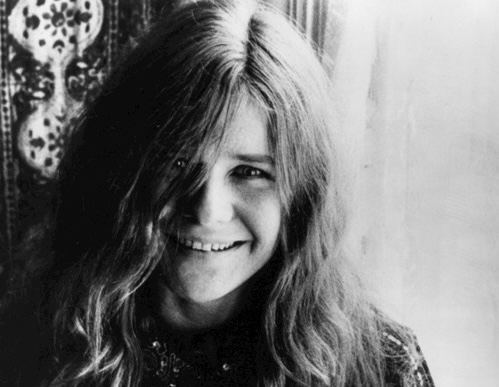
Andrew Curry writes: In January 1971, Columbia Records released Janis Joplin’s version of Me and Bobby McGee, written by Kris Kristofferson. It quickly went to number 1 in the US, but Joplin wasn’t around to see it. She had died of a drug overdose the previous October, a few days after completing her second solo record, Pearl.

Joplin’s wasn’t the first version of Me and Bobby McGee to be released. Roger Miller had had success with the song the previous year, as had the Canadian singer Gordon Lightfoot. Kristofferson, then regarded as a songwriter rather than a singer, had also recorded a version on his debut album. Because ‘Bobby’ is an androgynous name, especially in the US, it needs the smallest of changes to work for both male or women singers.
The secret of the song, I think, is that it is filmic, and the film is about the American mythos. As the opening verse says,
Busted flat in Baton Rouge, and headin’ for the trains
Feelin’ nearly faded as my jeans
Bobby thumbed a diesel down just before it rained
Took us all away to New Orleans.
In these early lines, you can see them, and you, in the cab of the driver’s rig, tootling on the harmonica, humming songs — “every song the driver knew”. And, then, with a key change, the song opens up, and suddenly, we’re travelling right across America, from the coalmines of Kentucky to the California sun, on the road again.
There’s more to be said about the song, but it’s worth pausing for a moment on its history. Success in the music business came late to Kris Kristofferson, and he had a few false starts. He was in his mid-30s by the time he signed to Monument records in the late 1960s, and while trying to crack the music business he’d worked as as a bartender, a construction worker, and flying helicopters to take oil workers out to the Gulf of Mexico.
And the history of Me and Bobby McGee is a bit of an accident. After Kristofferson had signed to Monument, the label’s founder, Fred Foster, challenged him to write a song about a studio secretary, “Bobbie” McKee (Kristofferson misheard the name). Foster got a song-writing credit for providing the inspiration.
Of course, with hindsight, Kristofferson’s songs stand comparison with those of any of his contemporaries: Help Me Make It Through The Night, Sunday Mornin’ Comin’ Down, Loving Her Was Easier, The Silver Tongued Devil and I, For the Good Times. They are apparently simple, but they are also subtle. And if they have a lived-in quality, it’s because he had lived many of them before he wrote them.

The killer couplet in Me and Bobby McGee is in the chorus, repeated only twice during the song:
Freedom’s just another word for nothin’ left to lose
Nothin’ ain’t worth nothin’, but it’s free.
You can’t listen to the song more than once without that phrase sticking in your mind. And the reason that it’s memorable is that Bobby McGee is a love song that’s about loss:
Then somewhere near Salinas, lord, I let her slip away
Lookin’ for the home I hope she’ll find.
The song that this reminds me of the most is Richard Thompson’s Beeswing. The two songs have similar qualities. Obviously they’re both about drifters, and tell travelling stories. The narrator of Beeswing similarly, has let her slip away:
[L]ike a fool I let her run with the rambling itch.
And Beeswing—the character—pays a price “for the chains you refuse.” Just another word for nothing left to lose.
I’m not sure that Joplin’s version of Me and Bobby McGee was the first time I heard the song. It seems more likely that I heard it on the Grateful Dead’s Skull and Roses live album, released in 1971, with Bob Weir (who died earlier this month) singing the vocals. It was a regular feature in the Dead’s live shows at the time.
But having listened to a lot of versions of the song by way of research, Joplin’s version is by far the best. Some of this is in the quality of her voice, and some of it is down to her backing band, Full Tilt Boogie, and the way the arrangement starts quiet and builds during the song. The organ sound (courtesy of the Canadian keyboardist Ken Pearson), which becomes more and more central as the song goes on, is at the heart of this.
Because, again, like Beeswing, the climax of Bobby McGee is about looking back with regret.
In Beeswing,
If I could hold her in my arms today/ Well I wouldn’t want her any other way.
And in Bobby McGee,
I’d trade all my tomorrows for a single yesterday/ Holdin’ Bobby’s body next to mine.
There’s a postscript to this, in the shape of a more recent song by the New York State musician Jim Gaudet called Bobby McGee and Me. The narrator meets a woman called Bobby McGee in a bar and has a perfect night with her before she moves on again. She’s named “after some old ‘60s song” by a father who drove an eighteen-wheeler truck. Spoilers, but later he discovers that she was on the run from jail. But “that one night was good enough for me/ For me and Bobby McGee.” No regrets.
—
Do join the Salut! Folk Facebook group at https://www.facebook.com/groups/2902595146676633/. You’ll get there immediately if you’re already on Facebook.
Leave a Reply