
Andrew Curry writes: In the second part of our series on the records that made the shortlist for the inaugural Folk Album of the Year Awards this year, we’re listening to the Irish band Poor Creature, the English duo Spafford Campbell, and the Scots musician Grace Stewart Skinner. The Awards are being run by Sound Roots and the podcaster Folk on Foot—the winner will be announced at a ceremony in March. Folk on Foot has also recorded interviews with each of the artists, and we have included those here in case you want to find out more about the artists and the records.
All Smiles Tonight, by Poor Creature

Poor Creature come out of the same energetic Dublin folk scene that has generated new Irish folk bands such as Lankum, Landless, and has nurtured performers such as Lisa O’Neill and John Francis Flynn. Two threads running through this are the producer, John ‘Spud’ Murphy, and the River Lea record label, and Poor Creature’s debut record is on River Lea and produced by Murphy.
The band was a creature of lockdown. Ruth Clinton (keyboards and vocals) and Cormac Mac Diarmarda (violin and other strings, guitar, accordion) are in different bands (Landless and Lankum, respectively), but they are partners in life, and during lockdown they started making music together. Later on they teamed up with John Dermody, the experienced drummer who had also played with Mac Diarmada in Lankum.
The sound is a mix of instruments with drones, loops and other effects, including percussion which reverberate around the songs. But in contrast the vocals cut through this, especially when Clinton is singing. A piece in the Irish Times describes it as “Goth Folk”, and makes connections with the Irish band Róis and the Welsh language trio Tristwch y Fenywod (both new to me). Many of these songs come from the Irish tradition in the 18th and 19th centuries—in the Irish Times interview Clinton quotes the English song collector Cecil Sharp, who said, “the songs aren’t good because they’re old, they’re old because they’re good.”
But they’re also fans of “country-and-Irish” music, and they honour that with a cover of The Whole Town Knows, sung by the Queen of Irish country music, Philomena Begley, and two numbers (including the title song) associated with the American country duo The Louvin Brothers. I only know this from doing some research: all of the songs on All Smiles Tonight have been enveloped in their very distinctive sound. I found the record quite exciting.
Here’s The Whole Town Knows:
And here’s the interview the band did with Folk on Foot:
https://overcast.fm/+AAOAK0s4tL8
Tomorrow Held, by Spafford Campbell
Owen Spafford and Louis Campbell met at the age of 18 when they were playing together in the National Youth Folk Orchestra, and they have been playing together—though not as Spafford Campbell—on and off since 2018. They’re both classically trained (Owen Spafford has been a nominee for BBC Young Composer of the Year), although Campbell has paid his share of folk music dues, playing with Sam Lee and Martin Simpson.
Their record company, Real World, describes the sound as including “elements of jazz, post-rock and chamber classical music while raiding the folk music toolbox“, while also nodding to Talk Talk’s 1988 record Spirit of Eden. Real World also throws a bunch of labels at the music: “post-folk. Trad-noir. Folk nihilism.”
If I’m being honest, I found this hard to get into, although I could hear what they were trying to do. This may just be me: people who are better judges of music than I am love it. But equally, I’ve heard Louis Simpson play with Martin Simpson, and he is a fabulous guitarist, and I think there might be more they can do with this sound.
All Your Tiny Bones gives a good idea of the sound of Tomorrow Held.
Here’s the interview that Owen Spafford and Louis Campbell did with Matthew Bannister of Folk on Foot:
https://overcast.fm/+AAOAK1s7Gcc
Auchies Spikkin’ Auchie, by Grace Stewart-Skinner
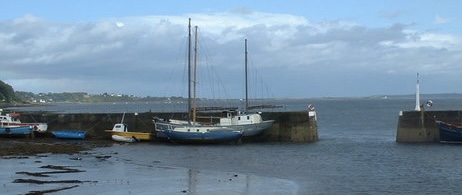
Grace Stewart-Skinner is a clàrsach (Celtic harp) player from the village of Avoch (pronounced “Auch”, with a hard ‘ch’ at the end) in the north-east highlands of Scotland. The village is on the Moray Forth, north of the Scots city of Inverness, and fishing has been a source of prosperity to the village for decades.
Auchies Spikkin’ Auchie is a celebration of her village, and includes members of her family, and others from the village, talking about the Auchie fishing tradition in their local dialect. She started out by making the recordings, and then wrote music to go with it, a task she described on a blog as being “a wee bit overwhelming”, having not written much music previously. (The blog includes an engaging sketch of how she planned this out.)

The music features Stewart-Skinner on clàrsach—this is the Scots version of the instrument made famous in the 1970s by the French player Alain Stivell—Rose Logan on fiddle, Rhona MacDonald on double bass, and Ewa Adameic on percussion. The harp player Rachel Newton worked with her as co-producer.
I have listened to this record a few times now, and it is terrific. The interplay of the Auchie voices and the Scottish tunes, and the way they are interpreted by the band, is fantastically evocative. You feel as if you’re being transported into her parents’ kitchen in Avoch.
The project was funded through a crowdfunder, with some help from Creative Scotland, and I’m going to insert here a link to her Bandcamp page.
https://gracestewart-skinner.bandcamp.com/album/auchies-spikkin-auchie
There’s also a trailer for the record on youtube.
And Folk on Foot’s Matthew Bannister interviewed Grace Stewart-Skinner about the record as part of the Folk Albums of the Year coverage.
https://overcast.fm/+AAOAK2Be88s
Part 1 of our coverage of the records short-listed as Folk Albums of the Year featured cynefin, the Gigspanner Big Band, and Barry Kerr.
And if you like folk, folk-rock or acoustic music, do visit the Salut! Folk Facebook group at https://www.facebook.com/groups/2902595146676633/.
Leave a Reply