
Andrew Curry writes: The Scots-Australian singer and songwriter Eric Bogle has written a huge body of work, and a lot of it is outstanding. But he’s probably best known for two anti-war songs, No Man’s Land (also known as The Green Fields of France) and The Band Played Waltzing Matilda. So on Armistice Day it seems like a good moment to write about one of these songs in our ‘Cover Stories’ series, where we compare and contrast different versions.

The Commonwealth War Graves cemetery at Tyne Cot. Photographer Jez Doak: Open Government Licence.
No Man’s Land was released in 1976, and was written after Bogle and his wife visited several of the vast Commonwealth War Graves that are dotted across Flanders and northern France. It is addressed to one of the soldiers buried there, “young Willie McBride”. He didn’t read the name on a gravestone – he said later that he needed something that rhymed with “graveside” and, writing against the anti-Irish mood of the times, wanted to remind people that Irish people had fought and died in the First World War.
The power of the song partly lies in the chorus:
Did they beat the drum slowly/ Did they sound the fife lowly/ Did the rifles fire o’er you as they lowered you down?
Did the bugles sing “The Last Post” in chorus? /Did the pipes play “The Flowers of the Forest?”
As a listener, you know that given the industrial slaughter of World War I that the answer to every one of these questions is likely to be “no”.
It’s been covered a lot since then. The Irish name might have been one reason why the Furey Brothers and Davey Arthur made it – as The Green Fields of France – part of their repertoire in the 1980s. In fact there are a lot of Irish versions: the Dropkick Murphys, the Clancy Brothers, the High Kings, Stockton’s Wing even the Celtic Tenors. Donovan has sung it, as have Peter Paul and Mary. Bogle’s favourite, apparently, is by the Scots-Canadian tenor John McDermott.
One of the first covers – a year after Bogle released the song – was by June Tabor, which combines it with the Scots lament Flowers of the Forest. In 2021, the Salut! Folk editor, Colin Randall, wrote about it. Tabor’s voice is made for this kind of material, and the arrangement on her record Ashes and Diamonds, with the arranger and keyboards player Jon Gillespie filling in a haunting piano piano track, is sublime. She must have been one of the first to cover No Man’s Land, since Bogle had released it only a year before.
There’s really only two ways to sing it: either as a lament, or in anger. The second approach was adopted by the folk-punk band The Men They Couldn’t Hang. They play it slightly faster, and a bit louder, and with a little bit of a snarl.
Anti-war controversy
The song has not escaped controversy. The celebrated peacemaker Tony Blair (this is English irony – Ed) once said it was his “favourite anti-war poem”. In 2014, on the centenary of the start of World War I – the singer Joss Stone and Jeff Beck did a rock version which was released as the official Poppy Appeal single, but also clipped off the verses at the end that are explicitly anti-war. This verse, for example:
And I can’t help but wonder, now Willie McBride/ Do all those who lie here know why they died?
Did you really believe them when they told you ‘The Cause?/ Did you really believe that this war would end wars?

Poppies at the Tower of London, 2014. Photo: Ian Cluley, via Flickr. CC BY 2.0.
The song also acquired a life of its own in Germany, where the tune, and the sentiment, were adapted for a song about a German soldier dying in France which became an anthem in the 1980s German peace movement. My German’s not good enough to translate the words of Es ist an der Zeit (It’s time), but apparently the lyrics are a lot tougher.
One of the conventions of the Cover Stories series is that we often choose a version. I’m a huge fan of June Tabor, but I think I’m going to opt for The Men They Couldn’t Hang. I think it’s a song that should be sung angry.
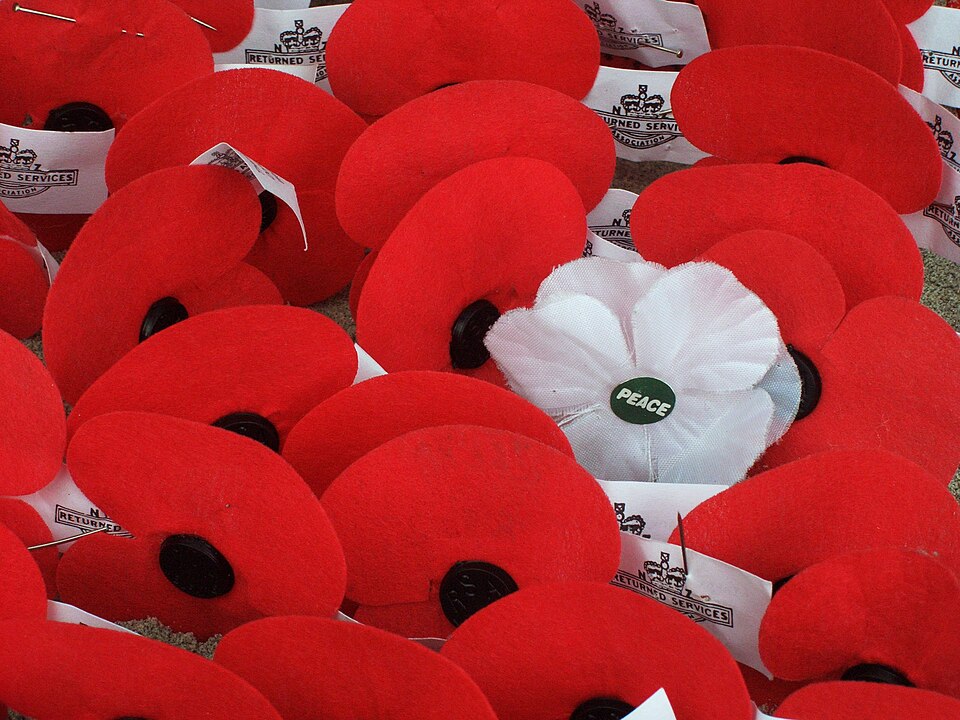
The featured image at the top of the post is of red and white Anzac poppies. Photo by Nankai, via Wikimedia. CC BY-SA 3.0.
—
Do visit the Salut! Live Facebook group at https://www.facebook.com/groups/2902595146676633.

Leave a Reply