
Just ahead of Martin Carthy’s 60th birthday, when I was The Daily Telegraph’s folk bloke, an enjoyable sideline to being a reporter, I persuaded the arts desk to send me north to his home above the lovely Yorkshire resort of Robin Hood’s Bay for an interview.
I’ll never forget it, him talking about still being a decent guitarist, “in my head” if less so in practice, but proudly thinking himself as having developed into a decent singer. Twenty-plus year later, he’s still on the road. Andrew Curry caught up with him.

Two folk greats: Linda Thompson and Martin Carthy, her squeeze back in the day
For the past few months Martin Carthy has been touring a show called In Conversation With, with the singer and music writer Jon Wilks. The clue is in the name. For a couple of hours Wilks guides Carthy through stories about his long career in particular and folk music in general. From time to time they play some songs. I caught up with it at King’s Place in London in December.
Right at the end of the show, Martin Carthy thanked Wilks for “picking him up off the floor”. He didn’t elaborate – the final applause was dying down at the time – but remember that his wife of 50 years, Norma Waterson, died last year.

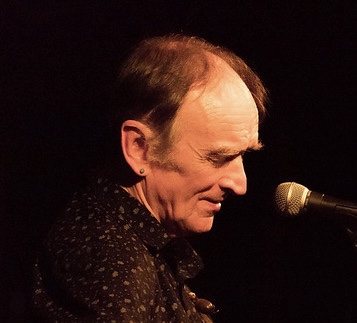
Photo of Martin Carthy by Mike Garvey at English Wikipedia
The format of the evening is simple enough. Wilks – an accomplished performer in his own right – started each half with a song, and then prompted Carthy to talk. From time to time, a Carthy story led to a song. Wilks had introduced him as “a human juke box”, and in the second half, certainly, the song selection seemed impromptu.
The first half of the show is more about Carthy’s part in the burgeoning British folk scene in the 60s, the second half more about guitar playing and the folk tradition. Steeleye Span and the Albion Band get name-checked along the way. The stories in the first half are unimpeachable – Bob Dylan and Paul Simon inevitably pop up, along with the rolling cast of names who emerged from the influential Greek Street folk club Les Cousins – even if Carthy seemed more animated in the second half.
Still, what’s not to like about a story in which Carthy and Dylan and a few others repair to Carthy’s flat after a show at the Troubadour in the bleak midwinter of 1962-63 and end up chopping up a wrecked piano for firewood with a samurai sword given to Carthy by his “pretend auntie” Emily, who was probably a spy.
Or the great bass player Danny Thompson phoning a despondent John Martyn, after his right leg had been amputated, to cheer him up by asking ‘Where do you want me to send the parrot?’
Carthy described the 60s Soho folk club Les Cousins as “a guitar school”; I hadn’t realised that there had been a skiffle club, the Skiffle Cellar, on the same site in the 1950s. Carthy’s theory about the 1960s folk guitar wave was that the skiffle boom had been so big, and so many guitars sold, that inevitably some of the players turned out to be talented.
Both Dylan and Paul Simon were fans of Carthy’s distinctive arrangement of Scarborough Fair. Dylan reworked it as Girl From The North Country, Simon more or less learned it and added it to his song Canticle. At the end of the first half Carthy played a different arrangement of the song, recorded with Norma Waterson and Eliza Carthy on The Gift.
The conversation turned for a bit after the break to Carthy’s innovation as a guitarist, which extend to his distinctive tuning — C G C D G A— and the slapped thumb on the bass string.
Influences? He mentioned Big Bill Broonzy – where he learnt the slapped thumb – and the American singer Elizabeth Cotten. He’d bought her record at Collett’s Music Shop on New Oxford Street, and later met her when playing in the US. Cotten was the Seegers’ housekeeper, and had a unique playing style, having taught herself to play left-handed on her brother’s guitar without being allowed to retune it.
The Seegers had helped her to win a court case against the skiffle singer Chas McDevitt, who had recorded her song Freight Train and sold a million copies of it. He’d thought it a traditional song – as I had until I heard this story. Carthy seemed quite wistful as he told it.
Carthy came alive when he talked about the folk tradition as a living thing — and prompted spontaneous applause from the audience on several occasions:
The whole tradition is the irresistible sound of human beings messing about with an idea. Try this, try that, see what works. You’re not going to kill it by changing it.
Right through the conversation there’s a strong sense that Carthy’s fascination with folk music is also driven by its radical spirit. He played Hard Times of Old England, written in the early 19th century. It was part of the repertoire of both Steeleye Span and The Imagined Village:
Everything in this song is happening right now. The only thing that tells you it’s from the 19th century is the word “tradesman” in the lyric. 200 years, and nothing’s changed.
He dedicated the song to Simon Emmerson, the moving spirit of Imagined Village, who died earlier in 2023.
Jon Wilks was a fan of Martin Carthy’s music before he became a friend. He talked about playing Carthy’s first solo record in his university room, and trying to teach himself High Germany, which Carthy sang here, while other students were listening to Britpop and trance music. He acknowledged how lucky he felt to be on stage interviewing him.
Martin Carthy is 82 now, and his playing isn’t as supple as it was. There were times when he forgot the words of the next verse and Wilks prompted him. It didn’t really matter. The audience (including me) was there, I think, to pay their respects to him for his vast contribution to British folk music. The stories and the songs were a bonus.
See also: Martin Carthy and Dave Swarbrick perform Byker Hill in Salut! Live’s Song of the Day series: https://www.salutlive.com/2023/12/song-of-the-day-martin-carthy-and-dave-swarbrick-byker-hill.html


Leave a Reply to Larry IslipCancel reply