
June 2021 update: there is no specific anniversary to justify reposting this item though it is half a century this year (inconveniently earlier this year) that Leonard Cohen‘s Joan of Arc was first released. And we’re far too soon, as in 10 years too soon, for the 600th anniversary of Joan of Arc being burned at the stake in Rouen.
But since I am delving into the extensive Salut! Live archive, cleaning up and republishing the content as I go along, I felt another urge to draw attention to by far my favourite performance of any Cohen song.
To warrant its inclusion in the Cover Story series I invited readers’ comments on the respective merits of Cohen singing the song solo and Cohen singing it with Jennifer Warnes, and I was not disappointed with the response you see below. My own view? Without her delivering Joan’s lines, I would have no lingering wish to hear it …
Joan of Arc, the Maid of Orleans.
Is this the song, maybe one among many, that confounds my electronic (and previously slow-mail) friend Leon Rosselson, a master songsmith, and his stern view of Leonard Cohen?
Read the linked piece at your leisure but the key extract is this: “The range of [Cohen’s] subject matter is remarkably small. In fact, his interests as expressed in his songs can be narrowed down to one: himself. He had no imagination. He was incapable of making up stories, of inventing characters which are the warp and weft of song.”
Rosselson’s case against Cohen may or may not be coloured by a sharply differing outlook on the Israel-Palestine conflict. His broader point is that poetry makes for poor music; he suggests Cohen viewed songwriting as a lesser art, to the extent of making do with half-rhymes and line endings that don’t rhyme at all …
Image by Gorupdebesanez

On the day I read news of Leonard Cohen’s death, I was perched on a high stool in a music shop in Ealing, west London, picking out the notes of That’s No Way So Say Goodbye on a Yamaha guitar which I then bought.
I like the song while acknowledging the fairness of Leon Rosselson’s criticism of what he calls its “nonsensical similes” (“Your hair upon the pillow/Like a sleepy golden storm”).
But there are plenty of other examples of Cohen’s work, too many to list here, that I would say also answer Rosselson’s complaint.
Which leads me to my Cohen song of choice. Joan of Arc, rightly a heroine of French history and wrongly treated by France’s odious Front National as its own property, was burned at the stake on May 30 1431, not by the wicked English but by the French at the behest of the wicked English after a trial that was a mockery of justice even by 15th century standards.
A friend, Fiona Barton, a former colleague and now a successful author (The Widow is a gripping, well-written thriller) , tells an amusing story from her time working during a languages degree course as a helper at a French children’s summer camp.
Colleagues made her stand up in front of all the young campers to apologise, in their language naturellement, for her countrymen having fait crémer Jeanne d’Arc. I am sure her efforts to undo harm done in the 100 Years’ War (actually it was 116 but that figure isn’t quite as eye-catching) worked wonders for Anglo-French relations.
Cohen’s song has gripping solemnity, an insistent melody, powerful imagery and some compelling lines …
She said, “I’m tired of the war,
Want the kind of work I had before”
… as well as what Rosselson might describe as sloppy rhyming, heart with Arc, dress with guests. It works for me. And if I had heard it sung only by Cohen alone, I might be satisfied with the essentially solo performance on his third album, dating from 1971.
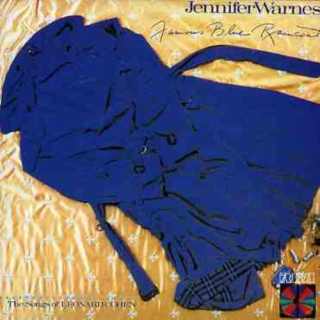
But since hearing the Famous Blue Raincoat tribute album by Jennifer Warnes when it was released in 1987, I have had time only for the sublime duet.
Warnes, who was among Cohen’s closest friends and performed with him on tour from the 1970s, is an accomplished singer and delivers the lines attributed to Joan with firmness and clarity, adding genuine vocal beauty to counter Cohen’s gruff monotone.
I turned for authoritative help to the Cohencentric: Leonard Cohen Considered website. There, Allan Showalter, a “devotedly irreverent” Cohen fan in Durham, North Carolina, writing as DrHGuy, considers the use of female voices for the purpose of “cushioning the imperfections” – a splendid phrase, though Showalter quotes it so may not be its originator – of the writer’s own voice.
Showalter refers to rigorous research by Tom Sakic (“ie listening to a staggering number of Leonard Cohen bootlegs”) that revealed the first such “featured female vocalist” to have predated Warnes.
He summarises Sakic’s findings: “During the 1976 tour, backup singers Laura Branigan and Cheryl Barnes sang the Joan of Arc lines together, a role that in later years would be assigned to a single vocalist. Moreover, Sharon Robinson and Anjani Thomas, who were the sole backup singers in 1980 and 1985, respectively, and who were not listed in the original post, also sang the female part of the Joan of Arc duet.”
Many diehard Cohen admirers may prefer to hear their man undiluted by female company.
As more of a Cohen dilettante, I am left musing that comparison of the two versions – without, for now, extending my own listening to Brannigan and the others – confirms my admittedly narrow-minded view that a long Cohen concert would perhaps not have been for me.
* Buy Famous Blue Raincoat at Salut! Live’s Amazon link by clicking on this sentence
Leonard Cohen: Songs of Love and Hate can be bought here and contains both the song under brief discussion and Famous Blue Raincoat. Joan of Arc’s chorus does have faint female accompaniment (Corlynn Hanney and Susan Mussmano, maybe) but this is unmistakeably Cohen solo.
And don’t worry: the commission I earn from Amazon if you do make purchases using my links will not make me wealthy.


Leave a Reply