
A former colleague, Bill Stock, once wrote this at Facebook, prompting me to trawl through Salut! Live archives and reproduce, from 2007, the little piece that follows.
It was originally published just ahead of a John Mayall gig in the French resort of Le Lavandou, where – when Covid permits – I spend part of each year …
First Bill, writing in 2017: "Met my all-time UK blues hero, the legendary John Mayall, at his gig in Southend tonight.
Bought a couple of signed CDs before the show (see next photo) and told John I first saw him at Bishop’s Stortford, Herts in the late 60s.
What an amazing gig. After playing non-stop for nearly two hours he and his fab band were given a well-deserved standing ovation by fans. Bear in mind that Mr Mayall was called up for National Service, served in Korea and has been playing the Blues since the Fifties, he sounded as fresh and sprightly as ever.
His multi-skilling abilities amazed me. On some numbers he played Roland or Hammond keyboards with his right hand, played a harmonica held again a microphone in his left hand while singing a few verses in between.
He also played superb rhythm and lead guitars. No wonder he was made OBE for services to music. And at the end of the show John and the whole band met fans in the foyer to sign more CDs and programmes and pose for more photos. Brilliant."
Now for my account of the musical journey that took me eventually to folk music … republication has prompted fascinating discussions at two Facebook groups, 6os 70s Facebook Folk Music and English Folk Music from which I have copied and pasted most of the comments you see below …
Billy Bragg once told me he was "of folk", though not "from folk".
The difference is subtle but not too hard to comprehend. Unless you are a Waterson, a Carthy, a Copper, a Doonan or a Lakeman, you are likely to have arrived at being "of folk" by this or that route.
How many generations a family needs to have had a strong interest in, and/or experience of performing, folk music before a member can accurately say he or she is "from folk" is open to debate. But for most of us, the test is academic.
Our parents hadn't the slightest interest; if there was music in the house it was the popular music of the age, or maybe light opera or piano lessons for the kids. So we found our own route to folk, or it found us.
We ourselves recoiled in horror from the likes of the White Heather Club or the Spinners whatever we later thought of either. And I certainly winced when hearing Alma Cogan or Pearl Carr and Teddy Johnson.
My route to folk included, odd as it may seem, John Mayall, the veteran British bluesman who [remember this was 2007] brings his band to the Théâtre de Verdure in my present home town of Le Lavandou, on the Med between St Tropez and Toulon, this Wednesday.
I'll be there, as – I suspect – will the mayor, since I am told he's a huge fan and has all the albums to prove it.
Everyone of my generation was aware of Bob Dylan and Joan Baez, of course, and in particular the protest songs they made popular.
Some popularity – though perhaps not too much – was important to our knowledge and appreciation.
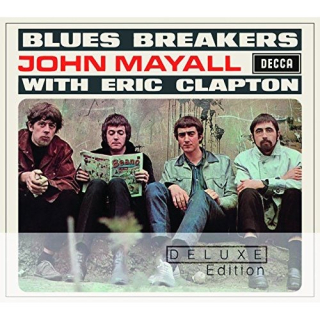
But we were also becoming aware of the blues, as played by British bands like John Mayall's Bluesbreakers.
It may have been an imitation of the real, black thing but it sounded passably authentic to most of us and Mayall already seemed old enough to have acquired a certain credibility on that score alone.
I remember lying on the floor of our sitting room listening over and again to Eric Clapton's guitar solo on Rambling On My Mind, played loudly enough to menace neighbourly relations.
(March 2021 update: I had always thought of that as a slightly shaming admission of teenage nerdishness.
Then I read, in a recent Observer interview, about Richard Thompson's memory of listening to Django Reinhardt, Lonnie Johnson and Les Paul as a boy and, to quote from his autobiography due out in April , “lying on a sea-green shag-pile rug in the living room with my ear a foot from the radiogram speaker”)
The great man with Bill Stock at the Southend gig described above
But where to find such music without attending big concerts in big towns?
The folk club! Someone had said so, and I had no reason to doubt it.
So off I went to Darlington Folk Workshop, in the Golden Cock pub on Tubwell Row.
And indeed, you could occasionaly hear, barely tolerated by the hierarchy, local youths singing their pale versions of the blues and Dylan, or their own flowery songs of varying quality.
But you also heard Byker Hill belted out unaccompanied by burly men, some of whom even knew all about working hard with their hands, or the lusty harmonies of visiting pros and semi-pros such as Dave and Toni Arthur.
Then, as you started exploring the other folk clubs in the area, you heard Irish ballads and rebel songs, Northumbrian dance music and relics of the Tyneside music hall.
I gradually grew more attached to the traditional music of the British Isles and less so to the blues and contemporary folk, without ever losing my fondness for those other genres. And at that Mayall gig, I will see how well that affection, slightly diminished as it may have become, in the British way with the blues has held up, and how vibrant and accomplished Mr Mayall has remained. [I wrote about how it went at this link]
Photo, from Seattle in 2019, by Joe Mabel, CC BY-SA 4.0,
* John Mayall, now 87, co-wrote with Joel McIver his autobiography, Blues From Laurel Canyon: My Life As A Bluesman. It was published in 2019.


Leave a Reply