
Colin Randall writes: since our deputy editor Andrew Curry brought his splendid grasp of history, detail and occasion to Salut! Folk, we’ve developed a tradition of coming up with playlists to mark specific dates or themes.
My own Saint Patrick’s Day list could go on for ever. Our rich archive contains lots of Irish music so I shall limit this to an album-size compilation of songs and tunes.
It has been assembled with the intention to cover musical depictions of hunger, rebellion, suffering and fun, love and loss, but most of all in the hope of sharing some beautiful sounds…

Photographed by Andreas F Borchert at the Church of Our Lady in Goleen, Co Cork
PLEASE VISIT AND MAYBE JOIN OUR FACEBOOK GROUP AT THIS LINK: https://www.facebook.com/groups/2902595146676633/
Track one: As I Roved Out by Dervish with Kate Rusby
There have been so many gorgeous versions of this song evoking the Great Famine that choosing just one is a challenge. Only recently did I come across this live performance, from the 2010 Celtic Connections festival in Glasgow, by the one of my favourite Irish bands. Cathy Jordan’s exquisite singing is complemented by a guest role for Kate Rusby, the two women taking alternate verses with lush accompaniment from the musicians.
Track 2: The Foggy Dew, by the Chieftains with Sinead O’Connor.
A superior Irish rebel song of the 1916 Easter Rising, sung to perfection by O’Connor, aided by the Chieftains’ exemplary musicianship. A Belfast curate, Fr Charles O’Neill, wrote the compelling lyrics to express disapproval at Irish blood being spilled on foreign soil in Britain’s war with Germany instead of in the cause of Irish freedom.
Track 3: There Were Roses, by Cara Dillon
Tommy Sands was inspired by real-life or rather real-death events to write one of the finest and noblest of songs about the Troubles. There Were Roses describes the evil, mindless tit-for-tat killings of two friends, one a Protestant and the other a Catholic. Here, it is sung with great sensitivity and aching melancholy. Cara Dillon grew up a short journey from Greysteel, the scene of another gruesome atrocity (eight pub-goers murdered by the UDA in a cynical targeting of Catholics in part-revenge for an equally despicable massacre at Frizzell’s fish shop on Belfast’s Shankill Rd).
Track 4: Lady Dillon: by Dordan
This is one of the most beautiful airs to be found in the vast repertoire ofthe blind harper and compsesr Turlough O’Carolan (1670-1738). Among contenders for the identity of Lady D, the clear favourite is the unfortunate Frances, who married as a teenager but died aged just 18. I am unaware of any ancestral connection to Cara Dillon.
The piper Liam O’Flynn recorded an excellent version but I have always preferred it with harp as the dominant instrument.
For reasons I have never properly understood, I cannot locate an online clip of my own runaway preference, by Maire Ni Chathasaigh and Chris Newman from their recording debut, The Living Wood, my choice when The Daily Telegraph‘s folk critic as album of the year in 1988 and among my top three albums of the decade. Dordan’s harper is Kathleen Loughnane.
Track 4: Reconciliation, by Ron Kavana
And after the Troubles, of course, there came what Mo Mowlam, a fine Northern Ireland Secretary, called the “flawed peace”. Even sooner, Kavana, an avowed republican, had written and released Reconcilation, a good song and a decent call for unity.
Track 5: Joxer Goes to Stuttgart , by Christy Moore
All their wars are merry, and all their songs are sad, wrote G K Chesterton in his 1911 poem The Ballad of the White Horse. Wrong. Let’s hear Christy Moore, and an exuberant singalong Glasgow crowd, and his hilarious account of Irish fans at the 1988 Euros in Germany.
Track 6: Rare Auld Times, by Imelda May
The mesmerising May sings her heart out on this feast of nostalgia for old and perhaps romanticised Dublin ar a concert marking the Dubliners’ fiddler John Sheahan’s 80th birthday. Yes, that’s Ralph McTell you see helping out behind Sheahan.
Track 7: Raglan Road, by Joan Osborne
Someone I regarded as an American pop singer, albeit a rather good one, suddenly popped up on the Chieftains’ album Tears of Stone, for which women were invited perform with the band. I wondered about selecting Joni Mitchell’s searing Magdalene Laundries or the Corrs’ foot-taping l Know My Love among others. And we’ve heard tremendous versions of Raglan Road by Luke Kelly, Mary Black and – of course – Sinead O’Connor. But no apologies for opting for Osborne.
This is the standout part of a great album.
Track 8: Bella Ciao, by The Tinkers
A powerful anti-fascist song from Italy, still an inadvisable setlist choice for artists in those parts of the country where Mussolini is still regarded with fondness. Who better to sing it than a rebellious London-Irish band with Maureen Kennedy-Martin’s irresistible vocals?
Track 9: The Fields of Athenry, by Tipperary Dance
Against the famine and the Crown, I rebelled, they struck me down ….. Not my favourite Irish song but it’s a grand crowdpleaser, nowhere more strikingly than at that most Irish of Scottish football stadiums, Celtic Park.
Tipperary Dance perform it with gusto, wow the crowd and provide a real treat.
Track 10: The Troubles of Erin, by Vin Garbutt.
Despite the unmistakable Teesside accent, Garbutt had a lifelong love affair with his mother’s native Ireland. He also had a strong following there, as I witnessed at a folk club in Downpatrick, reputed resting place of Saint Patrick. In this song, written in the year following the Good Friday Agreement, he appealed with shining eloquence for the survival and success of the peace process.
Track 11: Jack Hagerty, by Touchstone
A piece that would fly on to my Desert Island Discs selection (ha’way Lauren pet, where’s me invite?). The Bothy Band’s Tríona Ní Dhomhnaill formed Touchstone after moving from Ireland to North Carolina, recruiting three North Americans – Claudine Langille, Zan McLeod and Mark Roberts – to create a sumptuous blend, Irish meets bluegrass.
Track 12: The Island, by Dolores Keane
Added on merit but also as a Salut! Folk tribute to a formidable Irish singer. I heard she had died, aged 72, just a few minutes ago as I write. This is her heartstopping interpretation of one of Paul Brady’s best songs.
Track 13: The Lark, by Moving Hearts
As we have seen with Lady Dillon, not all memorable Irish music has words. The hugely influential musician, writer and producer Donal Lunny was a driving force in creating the innovative traditional/contemporary fusion Moving Hearts. From the all-instrumental album The Storm, The Lark is a pulsating piece summing up the artistic success of the project. Just listen to the energy ad excitement of Davy Spillane’s Uillean pipes.
Track 14: Song for Ireland, by Mary Black
Speaks for itself as a salute to the lure of one of the nicest corners of the world, even if the song was written by an English couple, Phil and Sue Colclough.
- Sadly it is not only Dolores Keane whose passing we must record. Among the many artists we meet above, we have also lost in recent times Liam O’Flynn, Mo Mowlam,Vin Garbutt, Sinead O’Connor, Phil and Sue Colclough, Luke Kelly, Ron Kavana, Paddy Moloney. Rest easy, all of you.

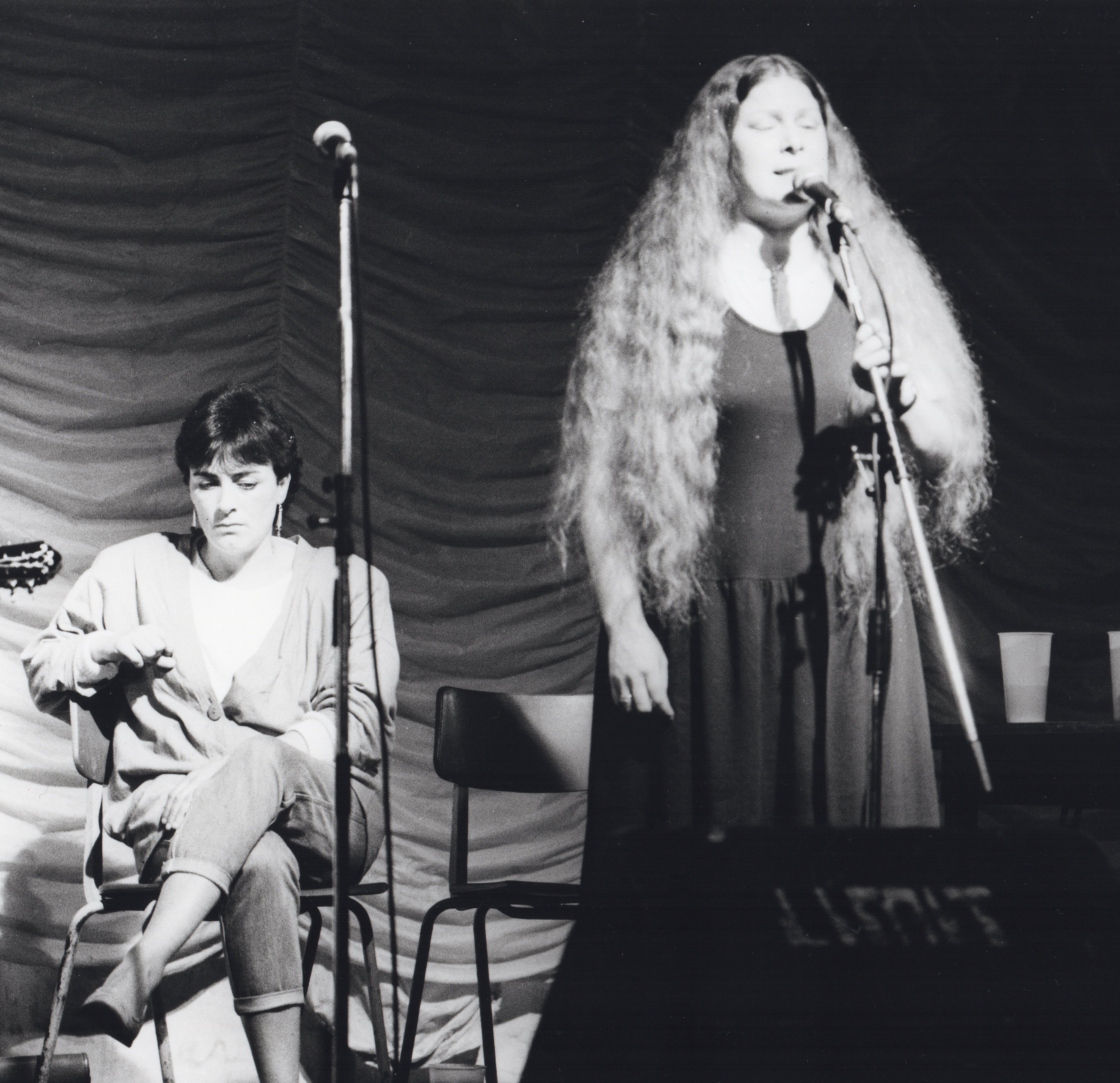
Mary Black with Dolores Keane at the 1985 Trowbridge folk festival. Image: Tony 1212
Leave a Reply